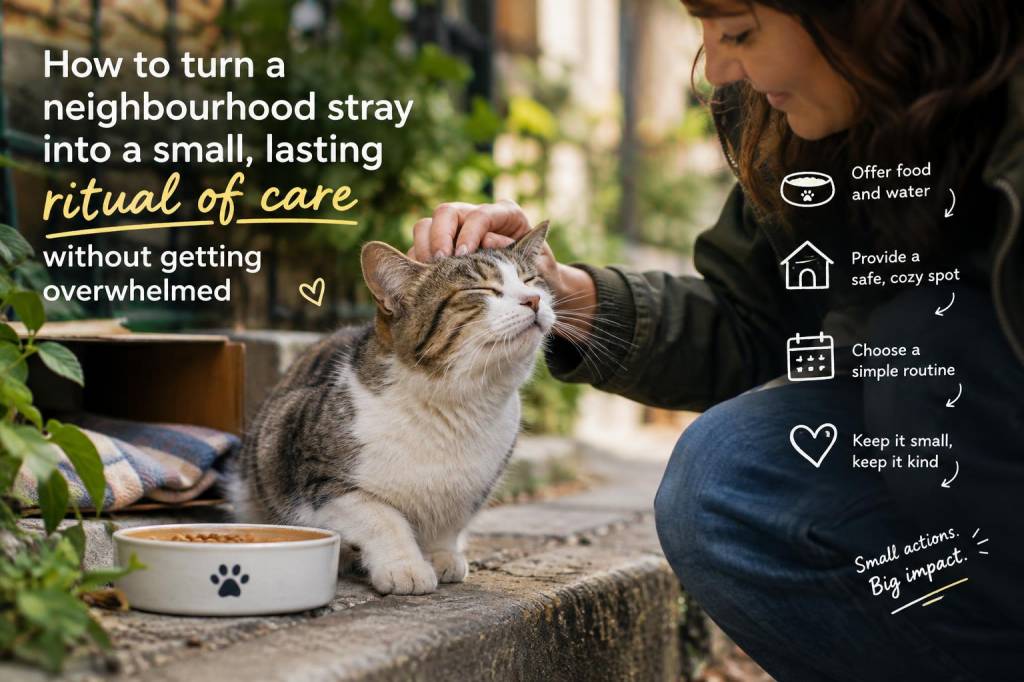
There is a small tabby that visits my street every evening. It first arrived last autumn — a cautious streak of orange slipping between parked cars, pausing to sniff the air as if deciding whether I was trustworthy. I started leaving a saucer of water and, on colder nights, a bit of cooked chicken in a shallow bowl. What began as a reflexive kindness has become, over months, a quiet ritual: an evening check-in that takes five minutes and colors the rest of my evening with a soft, companionable attention.
Turning a neighborhood stray into a small, lasting ritual of care can feel both tender and fraught. People worry about attachment, about responsibility, about inadvertently enabling a feral population or taking on something they can’t sustain. I worried too. But what I’ve learned is that a ritual doesn’t have to be grand or all-consuming to be meaningful. It can be a modest, repeatable practice that respects both the animal’s needs and your own limits.
Start small and observe
The first rule I gave myself was: observe before intervening. Strays vary widely — from skittish, semi-feral cats for whom human contact is terrifying, to friendly lost pets. I began by watching from my kitchen window for a few evenings. I noted when the cat came, what it ate, and whether it seemed injured or hungry in a way that a quick snack wouldn’t fix.
Observation serves two purposes. Practically, it helps you assess need without making assumptions. Emotionally, it gives you distance: it prevents you from jumping into a full rescue mode after a single sad image. You’ll quickly learn the animal’s rhythms and how best to offer comfort without overwhelming yourself (or the creature).
Make a tiny, sustainable plan
My ritual needed to fit into my life. I’m not available midday, and I travel occasionally. So I created a plan with three simple commitments:
These commitments are deliberately small. If I’m out of town, a neighbor can cover my evening bowl, but there’s no pressure to be the sole provider. That kind of slack is crucial to avoid burnout.
Set boundaries that protect you and the animal
Care without boundaries easily becomes caregiving by obligation. I decided in advance what I would and wouldn’t do. For instance, I won’t bring the cat into my apartment (I have allergies), but I will offer a safe, dry place at the edge of my porch if it looks like the weather will be harsh. I won’t attempt major medical interventions myself, but I will transport the cat to a vet if it’s injured or clearly ill.
Boundaries protect both parties. They keep your life manageable and prevent the animal from becoming dependent in an unsustainable way. They also make it easier to ask for help when the animal’s needs exceed your capacity.
Simple supplies that make the ritual easier
There’s no need for a lot of gear. I keep a small bag of supplies by my door. It takes less than a minute to grab and go. You might include:
Here’s a tiny table I made for myself so I could remember what to replenish before a trip:
| Item | When to replace |
|---|---|
| Wet cat food (6 cans) | Monthly or sooner if used |
| Bottled water | Weekly |
| Blanket/towel | Seasonally; wash monthly |
Communicate with your neighbours
One of the best moves I made was talking to my neighbours. It turns out the tabby had been seen by several people — some feeding it, some shooing it away. A quick group chat (we used our building WhatsApp) did two things: it pooled knowledge about veterinary options and created a shared expectation about feeding times and locations. It also spread the load: when I was away, another neighbour filled in.
Community doesn’t mean you’re absolved of responsibility; it means you don’t shoulder it alone. If you can, ask if anyone can take turns, or post on local Facebook groups or Nextdoor to find a more permanent solution, such as a rescue or foster volunteer.
Know when to escalate
There are moments when a ritual of small care isn’t enough. Signs that professional help is needed include obvious injury, signs of severe illness (lethargy, discharge from eyes or nose), or a rapidly growing colony of strays in distress. In those cases, contact local animal control, a rescue, or a low-cost clinic. Many cities have trap-neuter-return (TNR) programs; these reduce long-term suffering and population growth. I eventually found a TNR initiative through a local rescue and arranged for the cat to be neutered — it was the best way to care responsibly.
Manage your emotions
There’s a magnetic pull to these small acts of care, and with that comes emotional risk. You might become attached to an animal that belongs to someone else or to no one at all. I remind myself that the ritual is about consistent kindness, not a dramatic arc of rescue. Saying to myself, “I will do this five minutes each evening,” frees me to be present without being consumed.
When grief or worry creeps in, I journal or talk to friends. Small rituals are meant to sustain you as much as the stray. If they start to feel like a burden, reassess. It’s okay to adjust the ritual to protect your well-being.
Ritual as conversation
The most surprising thing about my tiny evening ritual is how it has changed the shape of my days. It’s the thing I think about when I’m rushing home, and it’s the quiet note that slows me when I return. It’s a small conversation with the neighbourhood, a way of noticing that the world includes other lives moving on different timetables.
If you find a stray on your street, you don’t have to become a full-time carer to make a difference. A few minutes each day, considered supplies, clear boundaries and a willingness to ask for help can turn an act of kindness into a steady rhythm. That rhythm, for both of you, becomes part of the neighbourhood’s gentle architecture of care.