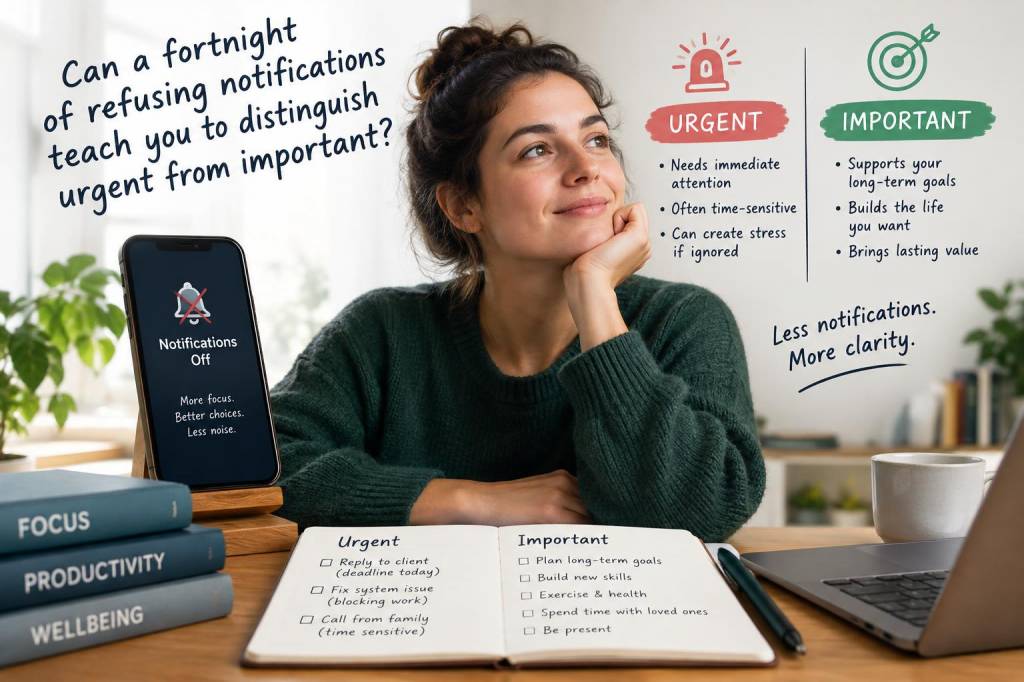
I decided, on a rainy Tuesday in March, to stop paying attention. Not permanently — that would be dramatic — but for a fortnight I turned off the small electronic faucets that drip pings, banners and vibrating little demands into the stream of my day. My phone's push notifications were mostly silenced, Slack was muted, and I closed the tab for my email client. The experiment was simple: see what happens when the world’s insistence becomes optional, and notice whether my sense of what is urgent changed at all.
The mechanics of my experiment
Before I cut anything off, I made rules that felt honest but modest. They were:
I used built-in tools: iOS Focus to create a Work profile that silenced personal apps, and Do Not Disturb for nights. On my laptop I adjusted notification settings and relied on Slack’s “Set yourself as away” and the email client’s snooze feature. No cleared inbox madness — messages piled up. The trick was resisting the pull to peek.
First week: the itch and the relief
The first 48 hours felt like being allergic to my own phone. My hand hovered over it unconsciously. A habit-born reflex — thumb-orbiting to unlock, to scroll — occurred even when there was nothing to see. Each time I remembered the experiment, there was a small surge of pride and a corresponding calm. Unexpectedly, the quiet highlighted tiny interruptions I hadn’t known I missed: the sound of boiling water, the rhythm of rain on the windowsill, a neighbour’s conversation through thin walls. My attention moved from externally imposed stimuli to nearer, softer ones.
Professional life continued; nothing exploded. A few colleagues messaged to ask why I was slow to reply, and then adapted. Three calendar alerts still bridged me to synchronous meetings. The rest — the newsletters, the promotional push, the app badges — were absent, and so were the mini-anxieties they had been instilling.
What stopped feeling urgent
By day five I noticed a pattern: many things that used to feel urgent in the moment were not actually urgent in essence. A headline that would have led me to open a news article and fume for an hour was now a line in my morning summary. A Slack ping about a minor decision had once triggered immediate response because silence felt like risk; now it simply waited. The are several categories:
Distinguishing these from real urgency felt like taking off tinted glasses. Without the dopamine friction of immediate feedback, my emotional state became less reactive, and my perception of what needed responding sharpened.
What still felt urgent — and why
Certain things remained genuinely urgent, or at least legitimately time-sensitive. These included:
What made these different was not volume but consequence. Urgency was tied to an objective cost: missed meetings, someone waiting in real time, or a technical issue compounding if not addressed. Crucially, urgency usually correlated with a human being expecting something in narrow timeframes — a direct social contract — or with systems that worsen if left unattended.
Tools and habitudes that helped
Turning off notifications isn’t a magic wand; it needs scaffolding. I leaned on small rituals and tools that made the experiment sustainable:
These measures created a boundary: silence wasn’t neglect, it was intentional selection.
Lessons in discernment
Two weeks taught me that urgency is, often, a social cue rather than an inherent property of an event. A message’s timestamp don’t make it urgent; a person’s reliance on an answer does. Learning to differentiate required asking three questions when a notification came to mind:
Answering these reduced the reflex to respond. I found a satisfying rhythm: deeper work blocks, punctuated by intentional communication windows. The sensation was not of missing things but of being chosen in relation to them, rather than chosen by them.
Unexpected side effects
There were small delights. I rediscovered the pleasure of uninterrupted reading — not merely skimming headlines but inhabiting an essay for an hour. Walks felt longer. Conversations in person regained depth because I wasn’t waiting for a screen-supplied adrenaline hit. Creatively, I noticed lateral thoughts returning; ideas that had been farmed out to distractive notifications found seedlings in the quiet.
There were also costs: occasionally I missed a time-sensitive opportunity because someone expected an instant reply; on two occasions I was mildly inconvenienced by delayed logistics. Those moments were useful calibrations — they showed where I needed to allow exceptions and where wider systems required different rhythms.
Practical takeaways if you want to try
After the fortnight ended, I didn’t restore every notification. The experiment didn’t feel like deprivation; it felt like editing. I re-enabled a few alerts, kept others off, and preserved the practice of checking rather than being checked. The disciplined silence taught me to hear the difference between the urgent and the important — and, more pleasantly, to prefer the latter when given a choice.