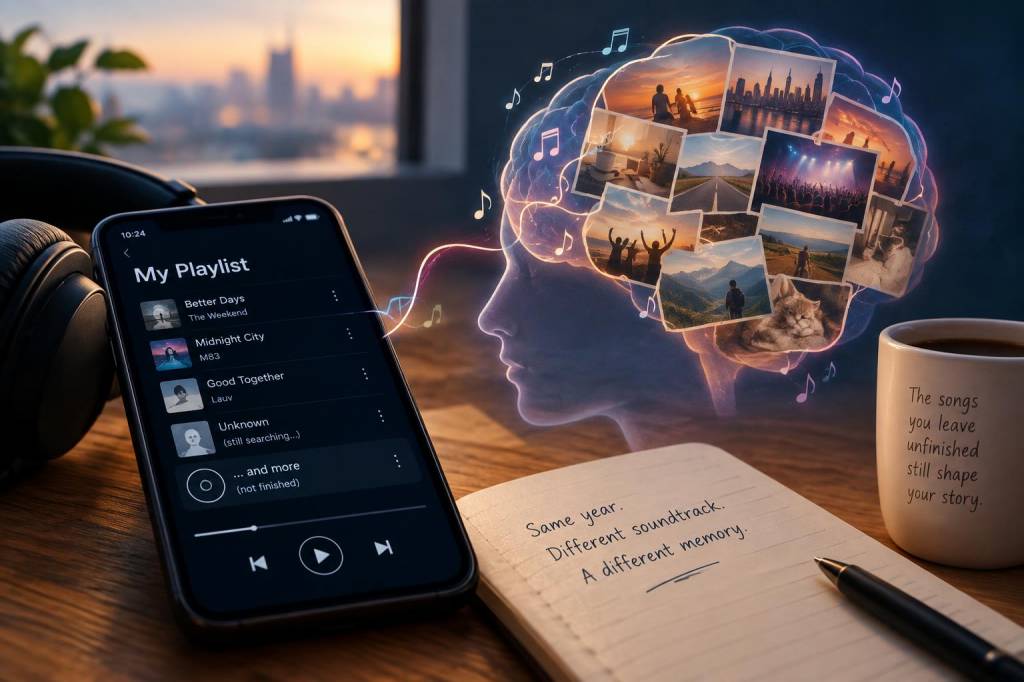
I kept one playlist unfinished for an entire year. Not unfinished in the casual way we abandon things—no, this was deliberate, a small experiment in memory and attention. I named it "2025 (still)" and added tracks as the months unfolded, sometimes curating whole clusters for a week, other times dropping in a single song that snagged me on a commute or in a café. I never hit “Done.” I never ordered it into a tidy sequence intended for replay. It became a living file, ragged at the edges, and the act of keeping it open changed the way I remembered that year.
Why an unfinished playlist feels different
There’s a cultural habit now of packaging time—end-of-year mixes, "best of" lists, highlight reels. They’re tidy, comforting, and often accurate in aggregate. But they also imply closure. To close a playlist is to declare a chapter finished, to say: this is the sound of that period. Leaving something open resists that gesture.
From the first week I made the playlist my default soundtrack for reflection. When a song arrived and I added it, the act felt like a small promise: I’ll remember this. But the playlist refused resolution. New songs elbowed older ones; tracks I once thought central dimmed against newer associations. The open-endedness of it created a peculiar kind of memory architecture—one that emphasized transitions, loose threads, and the way our recollections slide rather than lock into place.
How music stitches time
Memory is not a photograph; it's a weave. Songs act as threads that tie moments together. A melody can pull up a scent, a laugh, an argument, a walk. There’s plenty of research showing that music strongly cues episodic memory, which is why a haircut song can teleport you back to a summer, or a playlist can make a commute feel like a montage. But when you maintain a living, unfinished playlist, you’re doing something slightly different: you’re allowing the threads to cross and tangle.
Rather than pinning each track to a single, sealed memory, tracks become multipurpose anchors. "Song A" might be a January walk and also a rainy August evening by October. The unfinished playlist makes the network denser—each addition creates more overlaps and reassignments.
Three ways an unfinished playlist rewires memory
- It prioritizes process over endpoints. Because the playlist was never a polished "year in review," I stopped using it to confirm what the year was and started using it to witness how my tastes, relationships, and moods were shifting. The absence of a final cut forces attention onto movement: the ways I moved from one sonority to another, from one friend to another, from one project to the next.
- It cultivates associative layering. Songs do not sit in isolation; they compete and harmonize. When a new track arrives, my brain re-evaluates old ones, layering new emotions onto them. A song that once meant solitude might acquire a sense of mischief after a friend plays it at a party. Those layers become part of how I retrieve the year—less a linear story, more a palimpsest.
- It preserves uncertainty as memory material. Usually, memory pruning happens without us noticing—we tidy up, drop stray details. An unfinished playlist resists that neatness. Ambiguity remains audible: there are songs whose associations I never pinned down, and that uncertainty becomes an honest document of the year’s unresolved moments.
Small, practical rituals I used
If you’re tempted to try this, you don’t need an elaborate system. I kept the ritual manageable:
- Add a song whenever something feels noteworthy—not necessarily "important," just resonant.
- Occasionally—about once a month—I would listen through the playlist in order, not to finalize it but to notice patterns.
- Every three months I created a short note in my phone with the top three emotions the playlist had summoned. This wasn’t a review; it was a curiosity log.
I used Spotify for convenience—its cross-device syncing and easy shareability made it the simplest option—but the medium isn’t sacred. A local folder, Apple Music, or even a handwritten list of songs would work. The important thing is the openness, not the platform.
What this does to narrative
We often tell our lives as narratives: beginning, middle, end. The unfinished playlist disorders that narrative impulse. It discourages closure and invites return. Instead of resolving the year into a singular meaning, the playlist kept meaning plural and provisional. When I tried, mid-December, to write something like "the year was X," I found my sentence breaking into clauses—contradictory, small moments pressing in. The playlist had made me more tolerant of that contradiction.
Why that matters
Two things, mainly. First, memory shapes identity. If we smooth our past into tidy themes, we lose the jagged bits that reveal complexity. The unfinished playlist kept those jagged bits audible. I found myself more willing to hold multiple self-ascriptions—grateful and tired, hopeful and anxious—without forcing them into a single portrait.
Second, this approach affects how we attend to the present. When I listened with an openness that presumed incompletion, I became more alert to new associations. Instead of seeking a song to neatly summarize how I felt, I looked for sounds that complicated that feeling. That curiosity—rather than the rush to declare—made my days feel less like boxes to be ticked and more like rooms to be explored.
A small table of observed shifts
| Month added | Song | Initial association | Later reassignments |
|---|---|---|---|
| February | Indie folk track | Solitary walks | Late-night calls with a friend |
| May | Electronic single | Morning energy | Backdrop to a difficult conversation |
| October | Old pop song | Nostalgia | Shared joke at a dinner |
When the playlist resisted finalizing
There were moments when friends asked for my "year playlist"—a tidy share. I would laugh and say I kept it open on purpose, and I meant it. But there was also a quieter reason: the openness made the playlist a social object, an invitation. When someone suggested a track and I accepted it, that addition changed how we remembered a conversation. The playlist became communal memory in miniature.
Sometimes it was messy. Sometimes a friend would be hurt that a song they thought meaningful sat unnoticed amidst others. Those small frictions were part of the experiment. They revealed that memory is not only private; it’s negotiated. The unfinished playlist allowed for those negotiations to be ongoing rather than momentary corrections in a finalized archive.
How to resist over-curation without losing coherence
There’s a risk: an open playlist can become a junk drawer of half-remembered tracks. To avoid that, I kept two simple guardrails: first, I added only songs I’d played more than once or felt compelled to return to; second, I kept a short monthly note—three words—about why a new addition mattered. Those tiny constraints prevented the list from turning into noise while preserving its rough, provisional edges.
For me, the unfinished playlist didn’t produce a tidy retrospective. It rewired how I held a year: less as a closed argument with a conclusion and more as a room whose furniture had been moved around many times. That openness made the past less singular and the present more attentive—two small, practical shifts that felt quietly valuable.