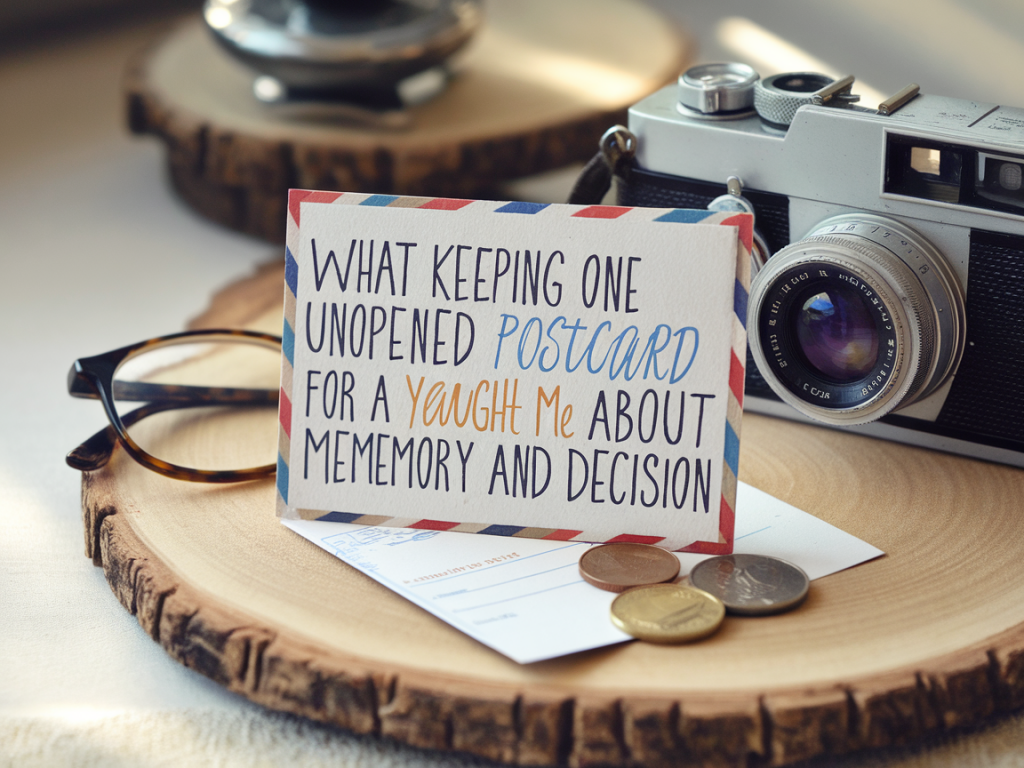
I found the postcard wedged behind a stack of mail on the windowsill, face down, its stamp still crisp and the handwriting faintly tilted as if whoever wrote it had been in a hurry and also smiling. I had known it was there — I remembered putting it on the sill a year ago when work felt hurried and the day felt full — but I hadn’t opened it. Not then. Not for a long time. Leaving it unread was an accidental experiment: a tiny, domestic delay that turned into a year-long conversation with memory and choice.
A small test, a slow noticing
At first the decision to leave the postcard unopened was practical. I was mid-project, a deadline pressing, and the idea of allowing a personal interruption felt indulgent. But as weeks became months, the postcard became something more than a piece of paper. It became a marker of time — a deliberate, quiet postponement. It mattered less what the message actually contained than the fact that I’d chosen to postpone knowing it.
Keeping it unopened forced me to notice how waiting alters the shape of expectation. When I finally decided to open it after a year, I realized that the anticipation had created a kind of shadow memory: I had imagined plausible messages, rehearsed reactions, and created tiny futures around a text I had not read. The postcard acted like a mirror held up to my tendency to fill absence with story.
What unread things teach us about memory
Memory is often portrayed as a filing cabinet or a search function: if you look, you find. The postcard reminded me that memory is also an imaginative process. In the absence of facts, the mind supplies them. A blank space invites invention. Over the year I’d taken up various versions of the postcard’s message: a thank-you, an apology, a travelogue described in three lines, even a sudden declaration. Each imagined note revealed not objective memory but the emotions I associated with the sender, the particular seasons of my life, and my own appetite for surprise.
There’s a practical lesson here. When something unread or unresolved lingers, our memory rehearses possibilities. That rehearsal is not neutral; it primes us. Sometimes that priming is helpful — it prepares us for relief, for delight. Sometimes it’s corrosive — building resentment or anxiety. The unopened postcard showed me that we often confuse these rehearsed futures with actual pasts. We act as if the imagined letter had been received and annotated, when in fact it is a fiction we’ve been feeding.
On decision and deferred agency
Choosing to postpone reading was also a choice to defer agency. For months I ceded a small domain of my life to indecision: who would I be when I read it? What if the message demanded a response? What if it altered something important? These were exaggerated fears — the stamp on the card wasn’t a legal contract — but they were meaningful because they illuminated a pattern. I realized I often defer decisions not because the decision is difficult, but because making it would require me to move. Movement can be inconvenient; movement requires a different self.
There’s a gentle logic to that: in a busy life, postponement conserves energy. But deferring becomes its own energy drain. The mental space occupied by “someday” takes up room. The longer the postcard stayed unread, the more my imagination stretched to fill the space it left: I found myself rerouting small choices through the hypothetical knowledge contained in that tiny rectangle of paper. It was a lesson in how procrastination is less about laziness and more about managing who we must become to act.
How objects earn emotional weight
Objects accumulate meaning by being connected to stories. The postcard, inert and insignificant, gained weight simply because I had invested it with suspense. It became not only a message but a repository of potential outcomes. I started to notice this in other corners of life too: an unworn dress in the wardrobe that represented “future self,” unread emails that felt like possible doors, a phone number I kept not to call but to imagine a call with.
Keeping the postcard highlighted how we anthropomorphize objects into time capsules. We assign them roles — keeper of apologies, messenger of regret, bearer of praise — and through those roles we negotiate change. Part of the fascination of objects is that they can hold these roles without answering. The unresolved object allows a conversation to continue indefinitely.
What actually happened when I opened it
When I finally sat by the window and slit the postcard open, the moment felt ceremonious. I prepared myself for an emotion made heavier by a year of speculation. The message was domestic and modest: a few lines about a market in Lisbon, a joke about the sender’s inability to pick a postcard, a line that said, simply, “thinking of you.” No scandal. No major revelation. But it mattered because of the year it had waited.
The affective reality of that moment taught me something quiet: anticipation can be more potent than outcome, and the act of opening was less about discovery than about recognition. The letter confirmed some things and unmade others. It didn’t produce fireworks, but it brought a gentle unknotting – a reminder that even small acknowledgements can be enough to settle a year of imagined scenarios.
Practical takeaways — habits for small decisions
- Notice what you keep unread: Identify the emails, letters, or items you postpone. Ask whether your delay is protecting you or making you anxious.
- Set a micro-decision rule: Give yourself a time limit for small unread things — a week, a month — after which you act. Micro-rules reduce the mental load without demanding dramatic change.
- Distinguish rehearsal from reality: When you notice you’ve invented scenarios around an unread item, name it. Saying “I’m imagining possible outcomes” can loosen their hold.
- Use opening as ritual: If something has been postponed, make opening it a small ritual. Brew tea, sit somewhere you associate with calm. Rituals can transform a decision into an act of care rather than dread.
What I learned about living with small mysteries
The postcard taught me to be kinder to small pockets of uncertainty. Not every unread thing is a problem to be solved immediately; some are invitations to live with a question for a while and see what changes. But it also reminded me to interrogate my reasons for delay. Is the wait protecting life’s margins, or is it a form of avoidance that quietly shapes decision-making in ways I don’t intend?
Keeping the postcard for a year was a small experiment with outsized lessons. It showed me how memory fills gaps, how postponement can become a habit, and how objects can carry futures as easily as pasts. It also showed me that opening — making a simple, human choice — is often less dramatic than the stories we build around it. Sometimes the act of knowing is just that: knowing. Sometimes it’s the doorway to a new little conversation.