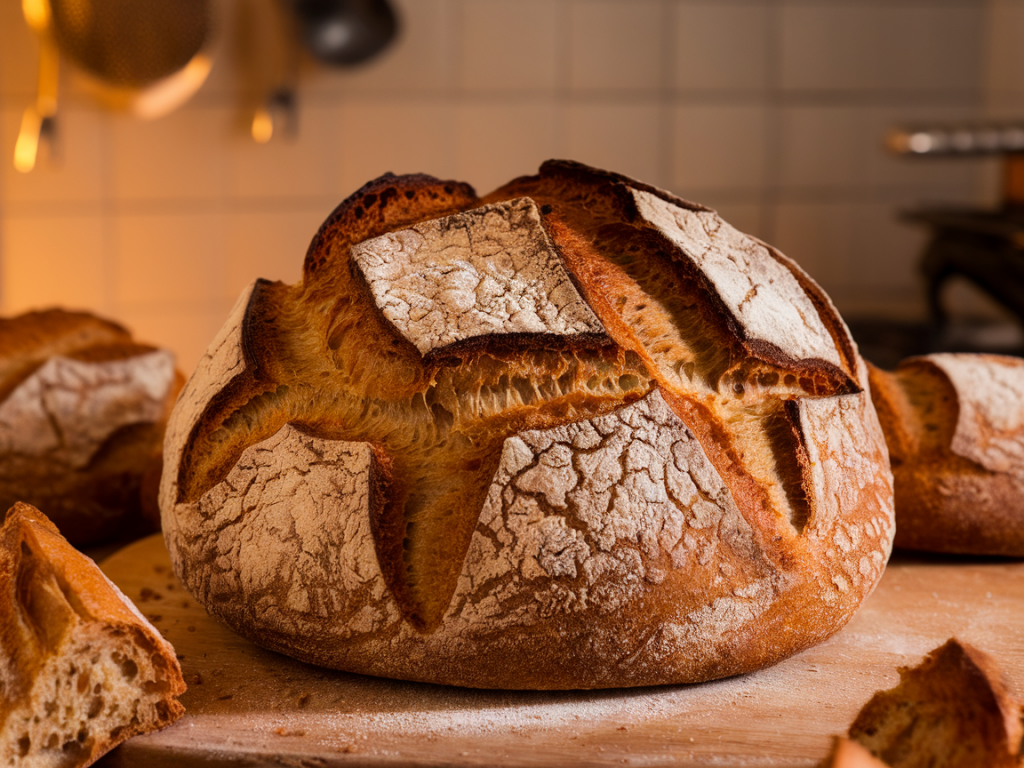
I once set a timer for bread and, like many of my domestic experiments, learned more from what went wrong than from what went to plan. The loaf came out dense where I expected air, crust thick where I wanted tenderness, and whole-wheat flour dusted the counter like an apology. I put the imperfect loaf on the table anyway, cut a piece, and found it unexpectedly consoling: my appetite didn’t require perfection. It required warmth, intention, and the quiet permission to eat something made with hands that were learning.
Why does a loaf feel like a life lesson?
People ask me, half-joking, whether everything becomes a metaphor when you write for a living. Sometimes yes, and baking is an especially generous one. Making bread compresses time and care into a small, sensible object. There is an initial act — measuring, mixing — and then an enforced pause: waiting for the dough to rise. The rest of the process unfolds in stages that you can neither hurry nor fully control.
That structure mirrors so many life projects: careers that gestate slowly, relationships that demand intervals of quiet attention, recovery that resists schedules. When your first loaf is imperfect, it asks a simple question: can you accept a result that is usable, nourishing and real, even if it isn’t picture-perfect? If the answer is yes for a piece of bread, perhaps it can be yes for the broader timelines we live within.
What does "messy timeline" mean?
By messy timelines I mean any progression of plans that refuses to align tidily with your intentions. A messy timeline might look like a delayed promotion, a relationship that takes longer to deepen than you imagined, a house renovation with continuous setbacks, or the simple way a creative project saunters along in fits and starts.
We tend to judge these timelines against clear, idealized markers: the perfect career ladder, the romantic narrative arc of meeting-dating-marriage, the Instagram-perfect renovation reveal. But life is not an editorial calendar. In practice, plans expand, stall, and pivot. The imperfect loaf embodies that: it didn’t follow the recipe's idealized trajectory, yet it still fed me.
How does one loaf teach tolerance?
There are three small lessons baked into that first flawed loaf.
- The value of iteration. My next loaf improved not because I read a new blog post but because I remembered how this one felt: where the dough was too stiff, how long it needed to rest. Failures are prototypes. Each imperfect attempt stores practical knowledge.
- Patience as an active practice. Waiting for dough to rise is not passive; it is an attentive patience. You check, you learn the scent of fermenting yeast, you notice how ambient temperature matters. That kind of patient attention transfers to projects with lengthy timelines. It trains you to be present in pauses instead of anxious about them.
- Grace for outcomes that are "good enough." Perfectionism insists on unbroken trajectories—no detours, no marks. Baking taught me to value sufficiency. A dense loaf served with honey and butter is still sustenance. A delayed manuscript that eventually finds readers still counts. Tolerance is the capacity to acknowledge adequacy while remaining open to improvement.
But what about ambition? Doesn’t tolerance breed complacency?
I get this concern. Tolerance is not synonymous with resignation. The loaf that taught me patience didn’t stop me experimenting with new flours or learning autolyse techniques. Rather, it shifted the tenor of ambition from impatience to inquiry. You can be ambitious and still kind to your present effort.
This means distinguishing between two impulses: the need to control outcomes and the desire to steward a process. Control often produces stress and rigid timelines; stewardship invites curiosity, feedback, and incremental refinement. When I approach a project as stewardship—be it a job, a relationship, or a garden—I'm more willing to tolerate detours because I believe that feedback matters as much as velocity.
How do you practice this tolerance day to day?
Here are modest, practical habits that helped me shift from deadline-anxiety to patient engagement.
- Short iterations: Break a big goal into mini-experiments. With bread, that meant trying a single tweak per bake. For writing, it might mean focusing on one paragraph or one scene rather than the whole book.
- Log progress: Keep a loose notebook where you note what worked and what didn’t. My baking notes are messy; my project notes are messier. Both remind me that progress is granular.
- Celebrate small wins: I put slices of the imperfect loaf on the nicest plate when I finished a difficult draft. Ritualizing small successes honors the present and makes slow timelines feel cared for.
- Talk about the process: Tell someone you trust what’s happening. When we voice the gaps between expectation and reality, the gaps diminish in power.
Does social media make it harder?
Yes. Platforms like Instagram and TikTok tend to showcase the finished loaf — glossy crust, perfect crumb, props. They can make the messy middle invisible. That curated storytelling compresses timelines into aesthetic outcomes and can make your real-time progress feel faulty by comparison.
I keep a small rule: for every polished image I see that makes me ache, I try to find the behind-the-scenes image or story. Seek the photo of the burned bottom, the early drafts, the fifth rehearsal. The internet contains both the edited final and the messy sequence that led there; choosing to look at the latter is a small practice of tolerance.
What about when timelines are painful—illness, grief, or structural obstacles?
Not every messy timeline is mildly inconvenient. Some are profoundly hard. A loaf cannot absorb the weight of grief, but the practice of tending something small can be gentle company in difficult stretches. It’s not a cure but a microstructure: a predictable set of actions that give your day rhythm and a modest sense of efficacy.
For larger structural barriers—inequality, systemic delays—individual tolerance is not the only or primary solution. Tolerating personal setbacks should not become an excuse to accept injustice. But sustaining patience with one’s own process can be a companion while you work toward collective change.
What I bake into my life now
I continue to bake. Not always well. Sometimes an entire batch collapses because I misread yeast. Sometimes a loaf is better than the photos. Each time, I try to approach the process with curiosity rather than judgment. I write that way too: drafts are for discovery, peer feedback is for sharpening, and timelines are invitations to learn pacing.
When a reader asks whether I ever get frustrated, the honest answer is yes—frequently. But the imperfect loaf taught me that frustration need not be an indictment. It can be a signal to adjust the temperature, fold differently, or rest longer. It can also be a reminder that the world often yields its best lessons through detours, not through strictly linear progress.
So try it: bake one imperfect loaf, or whatever small, manageable analogue suits you. Notice how waiting feels. Notice the small corrections you make. Notice whether you can extend that same grace to the longer, messier timelines that define a life. If the bread is edible, you'll eat it. If the timeline remains messy, you can still live within it, learn from it, and be, gradually, a little more tolerant of the beautiful, human fact that our plans rarely arrive on time.