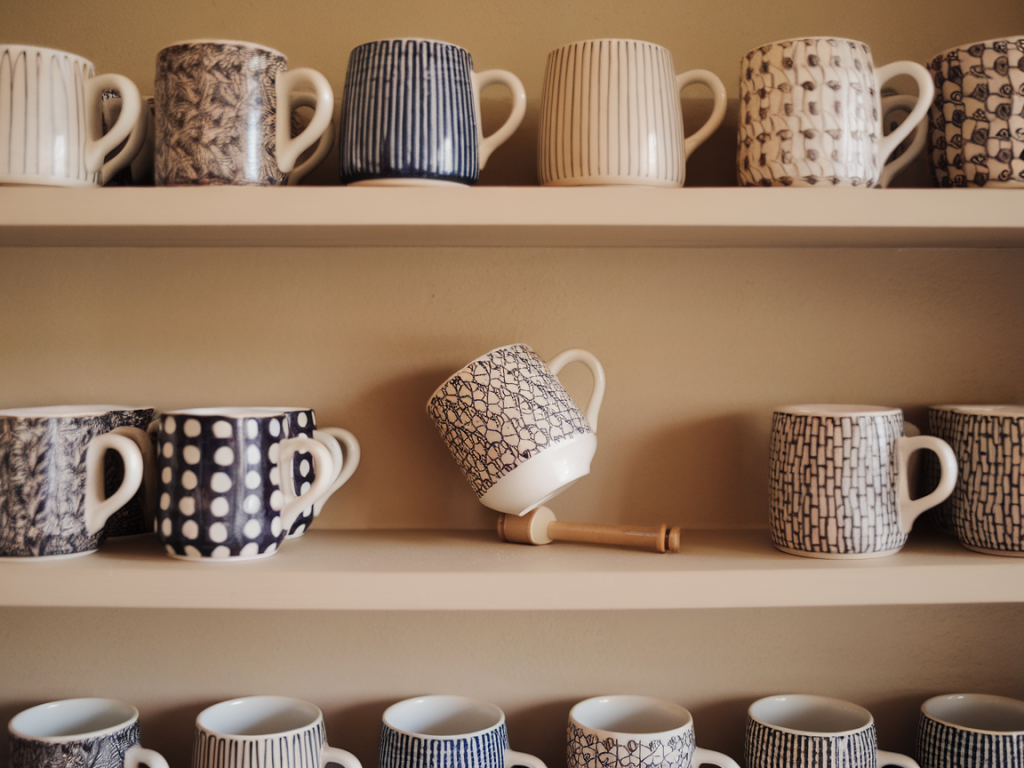
I own a shelf of mugs. That sentence sounds trivial until you notice, as I often do, that one of them is very much not like the others. It’s smaller, its glaze is a different kind of blue, there’s a faint hairline crack near the handle and a sticker from a weekend pottery market still clinging to the base. The rest of the collection obeys a palette — soft creams, speckled stoneware and a few uniform white mugs that came as a set from IKEA. That one mismatched cup, perched slightly forward, has a quiet stubbornness. It refuses to be assimilated.
People talk about identity in terms of wardrobe — what you wear, what you hide and what you choose to display. But I’ve been learning that the world of everyday objects can be a more honest, and less performative, mirror to who we are. A single cup on a shelf says things about us that a wardrobe often attempts to conceal.
Why a cup, of all things?
Cups are small and intimate; they are handled daily, warmed by our hands, and close to our mouths — gateways between the inside and outside. They live with us in ways that clothes do not. You don’t tuck your favourite mug into a drawer to be presented only at special moments. A mug sits in public, in the kitchen, where small decisions — put it on the shelf, rinse it immediately, leave it to soak — are made in passing. That continuous presence makes the cup a casual confessional.
Ask yourself: what does your favorite mug say about you? Do you prefer a sturdy, no-nonsense travel tumbler because your days are tightly scheduled? Or a bowl-like, handmade cup because you value the ritual of slow drinking? For me, the mismatched cup holds the memory of a morning at a pottery stall, a conversation with the maker, the awkward pleasure of choosing something just because it felt like a small act of kindness towards myself.
Expectation vs. attachment
Clothing is about presentation. Outfit choices are curated, often with an eye towards an audience — real or imagined. Mugs, on the other hand, accumulate through small attachments. I bought that blue cup because I liked the way it fit my palm, not because it matched my plates. I used it when I was writing a draft that went nowhere, when I received a late-night email that required a measured reply, when I allowed myself an extra slice of toast. The cup became a witness to moments I didn’t need to advertise.
That distinction matters. Clothing can be performative: we try to look like the profession, the mood, the people we aspire to inhabit. Objects accumulate differently. They attach to gestures and small rituals, and through repetition they become part of a quieter identity that is not merely aspirational but actualized.
What people are really asking when they notice the mismatch
- “Why does this belong among the others?” — Are you deliberately resisting conformity, or is it a leftover of some past you?
- “Is it sentimental?” — Does the object mark an event, a person, a lesson?
- “Does it clash with your aesthetic?” — Are your aesthetic choices coherent, or is your life more eclectic than your social media suggests?
These questions are often a way of asking: what narrative do you live? With that single cup, the answer feels refreshingly unpolished. It suggests a life that permits eccentricities, that allows for small rebellions against curated uniformity. It tells a story of curiosity rather than branding.
Objects as biography
We think of biography as the major plot points — jobs, relationships, moves. But there is a quieter, object-based biography that traces taste, failure, comfort and memory. The chipped saucer you keep speaks of clumsy mornings; the travel mug with a dent remembers a relay of trains and a friend who lent you their coat. The mismatched cup on my shelf charts an afternoon of wandering a market, a hesitancy to spend on myself, and then a small decision to say yes.
These objects also reveal how we narrate ourselves to the world. A carefully co-ordinated set of plates might say “I host dinners and have things in order.” A mismatched set, deliberately curated, might say “I collect stories.” The latter is less polished but more interesting. Identity, in this sense, is not a tightly tailored suit but a collage of bites, stains, scuffs and repairs.
Why we keep them even when they don’t ‘match’
There’s a practical answer: you can’t bring yourself to throw away something that still works. But there’s an emotional economy at play. The non-conforming cup often survives on sentiment, yes, but also on a commitment to variety. It resists monotony. When everything matches, you lose the little interruptions that pry open attention — the odd note in a song, the wrong color in a painting that makes you look twice.
Keeping that cup is a small refusal to homogenize life into a single aesthetic. It’s a way of acknowledging that you enjoy different kinds of things for different reasons and that your identity can tolerate contradiction. We are, after all, composite creatures.
How to read your life through your shelves
If you like exercises: stand in front of a shelf and pretend it’s a map. What objects appear at the edges, the center, the topmost plane? Where is wear most evident? The mismatched cup is often near the front because it gets used; the gloss fades where hands touch most. That proximity to use tells you what in your life is habitual and intimate — the rituals that shape your day.
- Look for provenance: where did each object come from — a shop, a friend, a secondhand stall?
- Notice frequency: which of these do you reach for without thinking?
- Identify repairs: what got mended, and why?
These simple observations reveal priorities without the self-consciousness of a curated wardrobe. They map how you move through your days rather than how you want to be seen on a particular evening.
The politics of being ‘mismatched’
There is a social dimension too. Matching is often associated with wealth, time, and an audience who values cohesion. Mismatch can signal thrift, improvisation, or an aesthetic that privileges story over brand. For those who fear judgment, a mismatched cup might feel like a slip. For others, it’s a proud flag of autonomy.
On a personal note, I find that my cup’s defiance is a small practice in not performing. In a world that constantly offers us templates — what to wear, how to decorate, which mug to buy if you want to belong to a certain tribe — keeping that one odd cup is an act of permission. It says: what matters to me isn’t uniformity; it’s the accumulation of little, honest pleasures.
So next time you pass a shelf, look for the odd one out. Not as an invitation to tidy, but as an opportunity to read the quiet annotations of a life. Those mismatches are less about chaos and more about meaning — a vocabulary of the ordinary that says more about who we are than the neat rows of a wardrobe ever will.