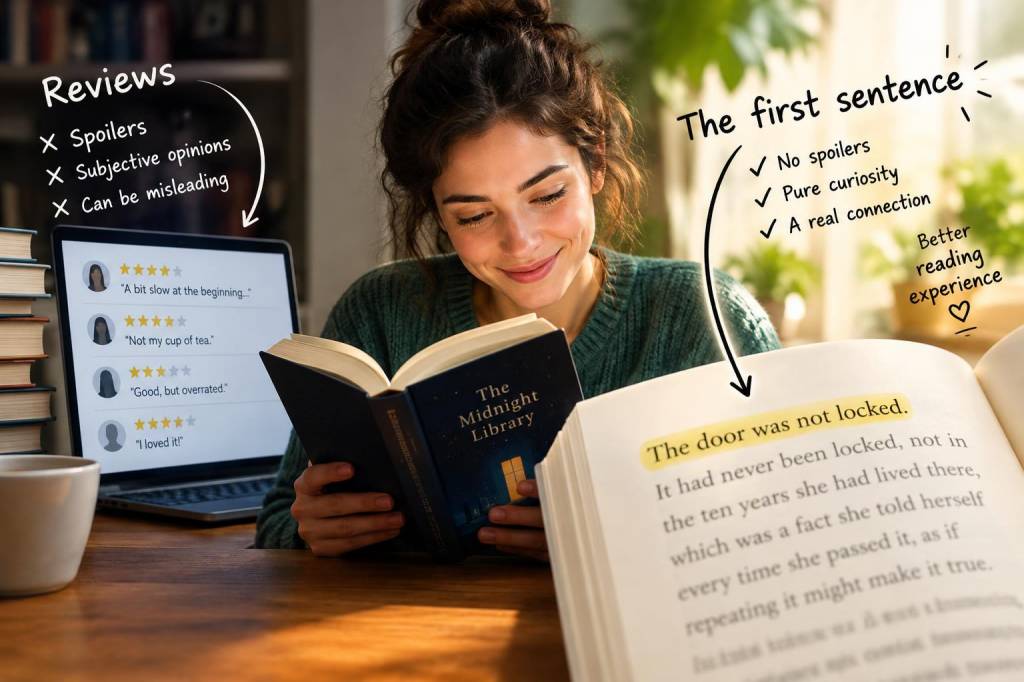
I have long suspected that reviews are useful in the way weather forecasts are useful: they may prepare me for conditions, but they rarely tell me what it will feel like to stand inside them. A review can summarize a novel’s shape, praise its intelligence, warn me about its flaws, and still fail to answer the one question that matters most when I am about to begin reading: will this voice meet me where I am? That is why I have increasingly found myself choosing books by their first sentence, or at least by the opening paragraph, rather than by the accumulated verdicts of strangers.
It is not that I think reviews are worthless. I read them often, and with interest. They can alert me to a book’s themes, help me avoid something wildly misaligned with my mood, and occasionally persuade me to try a writer I might otherwise have overlooked. But reviews speak from after the encounter, while the first sentence speaks from the threshold. It is the beginning of a relationship, not a report about one. That difference matters more than I once admitted.
I began paying closer attention to first sentences after noticing a pattern in my own reading life. The books I loved most rarely won me over because someone explained them well. They won me over because, within a line or two, they established a rhythm I wanted to live inside. Some sentences arrived with wit, some with unease, some with plainness so exact it felt magnetic. The ones that stayed with me did not ask for approval. They offered a doorway. I stepped through.
There is something almost intimate about a first sentence. It is the first contact between writer and reader, but unlike an introduction at a social gathering, it cannot rely on politeness alone. It must do several things at once. It must suggest a voice, create a mood, and offer a reason to continue. When it succeeds, I feel a small but unmistakable click of recognition, even when the subject is unfamiliar. I may not yet know whether I trust the book, but I know whether I want to hear more from it.
Reviews, by contrast, often flatten this experience into a set of claims. They tell me a book is moving, ambitious, overrated, atmospheric, or slow. Those descriptors may be accurate, yet they are still abstractions. A book can be “slow” in a way that feels meditative and generous, or in a way that feels labored and dull. A book can be “ambitious” in a way that is thrilling or in a way that is merely busy. A review cannot fully transmit this texture. The first sentence can.
I remember a period when I was trying to read more deliberately and had fallen into the habit of relying on lists, awards, and reviewer consensus. I was doing what many thoughtful readers do: attempting to optimize pleasure through informed selection. Yet the result was oddly sterile. I was picking books that seemed correct rather than books that seemed alive. Then, one afternoon, I opened a novel because a single line arrested me. It was not a famous line, not one widely quoted, not even especially extravagant. But it carried a pulse. It made me feel that some distinct intelligence was speaking directly into my hands. I bought the book on the spot and loved it in a way I can still remember.
That experience changed my sense of what a reading decision can be. I stopped treating the first sentence as a decorative flourish and started treating it as evidence. Not evidence of quality in any absolute sense, but evidence of relation: relation between language and attention, tone and appetite, expectation and temperament. A first sentence cannot prove that a book will satisfy me, yet it can reveal whether its method of approach feels compatible with mine.
What I notice most in a compelling opening is not spectacle but precision. I am drawn to sentences that know exactly what they are doing. Sometimes they are elegant, sometimes blunt, sometimes sly, but they always seem to understand the burden they carry. A strong opening can suggest confidence without arrogance. It can create mystery without confusion. It can invite me in while refusing to flatter me. That balance is rare, and when I find it, I trust it more than a chorus of enthusiastic reviews.
There is also a practical side to this preference. Reviews tend to influence me when I am uncertain, but uncertainty is not always the problem. Sometimes I am simply tired of being told what to think before I have had the chance to think anything at all. Reading, for me, is partly an act of surrender and partly an act of discovery. I want to be surprised by a book on my own terms. The first sentence gives me a starting point that belongs to the book itself, not to the commentary around it.
I have also come to appreciate how first sentences reveal a writer’s ethics. By that I mean the habits of attention, restraint, and candor that shape the work to follow. A sentence may be ornate, yet if it is precise, I sense care. A sentence may be plain, yet if it carries intelligence and timing, I sense discipline. A sentence that tries too hard may tell me more than the review that praises the book’s brilliance. It can reveal anxiety, performance, or overexplanation. A good opening often contains a quiet contract: trust me, but only because I have earned it.
Some readers prefer to sample a chapter before deciding. I respect that instinct, and I use it too. But I think the first sentence has a special status because it is the most concentrated expression of a book’s identity. It is the place where intention first becomes audible. If I like it, I am not just liking style. I am liking the prospect of spending time with a mind. That prospect matters. Time is finite, attention is fragile, and a book asks for both.
In recent years, I have tried to notice what kinds of openings consistently win me over. I seem to respond to sentences that have one of three qualities:
- a clear voice that feels immediately inhabited;
- a tension between what is said and what is withheld;
- an image or rhythm that suggests a larger world waiting nearby.
These are not rules, only patterns I have noticed in myself. A book can lack all three and still become beloved. Yet when I am standing in a shop or scrolling through an online catalogue, these signals often matter more than a star rating or a polished review quote. They are personal indicators, and reading is, after all, deeply personal.
One reason reviews can mislead me is that they often assume I am looking for argument, when I may actually be looking for atmosphere. A reviewer might tell me a novel is structurally daring, but what if I am craving warmth? Or they may praise a memoir’s honesty, while I am really searching for lyrical restraint. The first sentence is not a universal recommendation system, but it is a more immediate expression of mood. It helps me sense whether a book belongs to the weather of my mind at that moment.
I have learned to trust that weather. On certain days I want a book that opens with urgency, and on others I want one that arrives quietly, almost politely, then settles in beside me. Reviews rarely tell me which kind of companionship a book offers. A first sentence often does. It can sound impatient, comic, grave, tender, philosophical, or unsettled. It can hint at whether the book will rush, wander, confess, or observe. That matters because I do not read only for content. I read for cadence, disposition, and company.
| Signal | What I learn from a first sentence | What a review often misses |
| Voice | Whether I want to listen longer | The exact tone of the speaking mind |
| Rhythm | Whether the prose feels natural to me | The bodily experience of reading it |
| Promise | What sort of journey may follow | The subtle contract between book and reader |
| Mood | Whether it suits my present state | How mood changes over the first pages |
I do not mean to pretend that a first sentence is sufficient. Plenty of books begin brilliantly and then drift, just as plenty of books begin modestly and grow extraordinary. Yet the same can be said of reviews. A review may be insightful and still lead me nowhere useful. I would rather begin with the book’s own voice than with a description of its supposed merits. If I am going to risk disappointment, I prefer to do so in direct conversation with the text.
There is a small thrill in this method, too. Choosing by first sentence feels slightly illicit, as if I am bypassing a gatekeeper and going straight to the source. It restores a sense of discovery that can be lost in an age of recommendation engines, ranking systems, and endless opinion. I do not want algorithms or consensus to tell me what I should love. I want to be surprised by language itself. The first sentence, when it is alive, still has that power.
Sometimes I test my instinct by reading the opening aloud. Sound reveals what silent scanning can hide. If the sentence resists my mouth, it may still be interesting, but if it gathers itself naturally in speech, I pay attention. I am not looking for perfection; I am looking for a pulse. A first sentence with pulse suggests a writer who understands pace, emphasis, and breath. Those are small things, perhaps, but small things often determine whether I keep reading.
I have also noticed that the books I choose this way often become more memorable because my attachment begins before I know where they are going. I meet them as voices, not as products. That early intimacy alters the reading experience. I am not evaluating from a distance; I am participating from within. Reviews can be helpful after the fact, when I want to place a book in context or compare reactions. But before reading, I want a direct spark, not a mediated verdict.
So I still browse reviews, but I no longer let them have the final word. If a book catches my eye, I read the first sentence first. If that line feels lifeless, I move on, even if the praise is loud. If that line is vivid, strange, elegant, or somehow unmistakably itself, I give it a chance, even when the reviews are mixed. More often than not, that instinct leads me somewhere rewarding, and even when it does not, I feel I have made the choice honestly, in conversation with the book rather than its reputation.
And perhaps that is what I want most from reading anyway: not approval, not consensus, not even certainty, but a fresh encounter with a voice that knows how to begin.