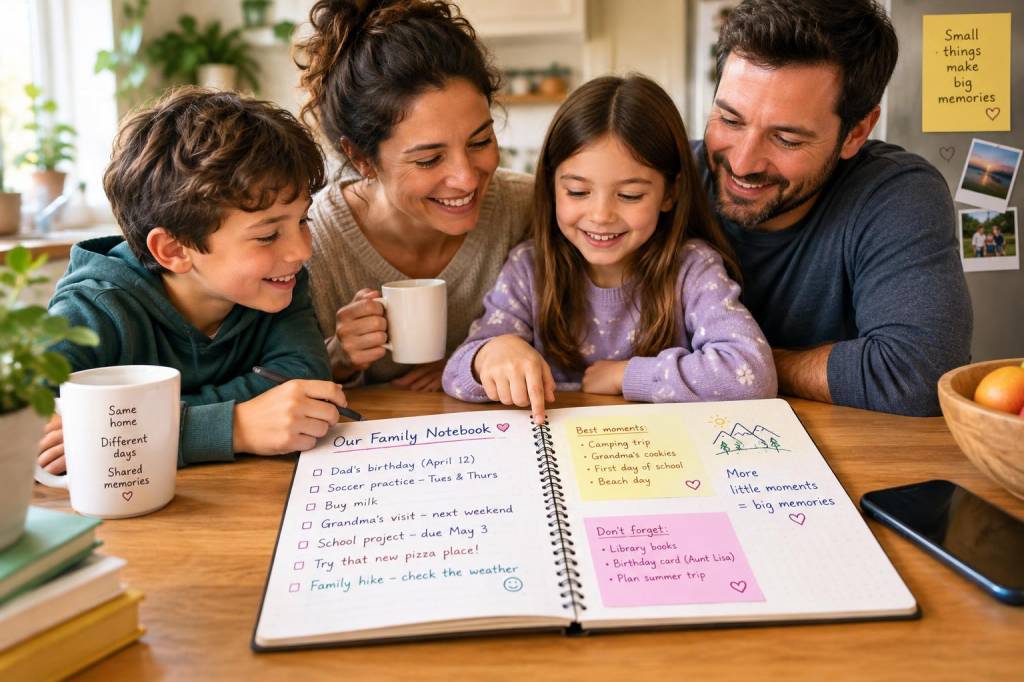
I did not expect a small notebook in the kitchen to change the emotional climate of a home, yet that is exactly what happened. It began as a plain, soft-covered notebook left near a jar of pens on a shelf by the phone charger. No ceremony, no announcement, no grand intention. I simply wanted a place where a family could leave little notes for one another without needing to catch anyone at a perfect moment. What followed was not dramatic, but it was quietly transforming.
Most households already have a way of recording what matters: calendar alerts, phone reminders, messages scattered across group chats, sticky notes on the fridge, occasional voice notes sent in a rush. Those tools are useful, but they tend to fragment memory. A shared notebook does something different. It gathers the small things into one visible place and turns them into a shared household story. It is not only a record of tasks. It becomes a record of attention.
Why I wanted one place for small things
I first noticed a strange pattern in family life: we often remember large events clearly, but we lose the small details that give a house its texture. Someone mentions a funny thing a child said at breakfast, and by evening it is already half gone. A recipe tweak disappears. A tiny victory at school gets buried under laundry and errands. A passing observation from a partner, a request from a child, a reminder from an older relative, all of it can vanish unless someone makes a note.
I was not looking for a perfect system. I wanted something human. I wanted a place where a comment like “Milo finally learned to ride without training wheels” could live beside “Need oat milk again” and “Try that lemon pasta with basil.” In my mind, these things belonged together because family life is built from exactly that mix: memory, maintenance, and everyday delight.
A shared notebook gave those scraps a home. It changed the feeling of remembering from an individual burden into a collective habit. Instead of one person carrying everything in their head, everyone could deposit a thought, a reminder, or a moment worth saving.
What started appearing on its pages
At first, I thought only practical notes would make it in. I imagined lists of groceries, appointment reminders, and the occasional message about bins, bills, or school forms. Those things did appear, of course, because domestic life is never far from logistics. Yet the notebook quickly became something richer. Once it was there, people began writing the kinds of details that usually go unrecorded because they seem too small to matter.
- A child’s exact wording after coming home from school
- A song that was playing when everyone was cooking together
- A restaurant name someone wanted to remember for later
- A tiny act of kindness that might otherwise have been forgotten by morning
- A household joke that made everyone laugh far more than expected
- A note about which plant had finally produced a new leaf
These entries might seem trivial when seen separately. Together, they formed a living archive of daily life. I began to see that memory is not only about preserving major milestones. It is also about noticing what repeated attention turns meaningful.
Why handwriting changes memory
I have always trusted handwriting more than I expected to. There is something about moving a pen across paper that slows the mind just enough for a thought to settle. Typing is efficient, but efficiency is not always what memory needs. A handwritten note asks for a little more presence. It is slower, yes, but that slowness can make a thought feel more deliberate and more worth keeping.
When I write in the notebook, I notice that I remember the moment more vividly later. Not every detail, of course, but enough. I remember the light in the kitchen, the sound of someone washing dishes nearby, the mood of the conversation. Even when another family member writes a note, I often recall the moment in a more textured way because I have seen it on paper, not just in a notification window that disappears with a swipe.
There is also a subtle emotional effect. A handwritten line feels like it belongs to a person in a way that a quick digital message sometimes does not. I can still see the shape of someone’s handwriting, a little rushy or careful or looping, and that visual trace becomes part of the memory itself.
What changed inside our conversations
The notebook did more than store information. It altered the tone of our conversations. Because a thought could be written down and left for later, there was less pressure to make everything happen immediately. If someone wanted to share an idea, they could do so without needing to interrupt what another person was doing. If I forgot a detail, I could check the notebook instead of asking again and again. That small shift reduced friction in ways I did not fully expect.
It also made room for gentleness. Some things are easier to say on paper than out loud. A request, a worry, a suggestion, even a note of gratitude can land more softly when written down. I found that family members sometimes used the notebook for messages that were too minor for a formal conversation but too meaningful to ignore. “Thanks for fixing that shelf.” “Loved the pancakes.” “Can we keep the window open at night?” These are not dramatic statements, yet they create a warmer household atmosphere when they are visible and acknowledged.
Perhaps most interestingly, the notebook made us less likely to assume that someone else would remember for us. When a thing mattered, it went into the notebook. That simple rule created a culture of shared responsibility and shared noticing.
What I learned about family memory
I used to think family memory lived mostly in stories told at special moments, in photos, or in recollections of important days. Now I think memory is also made from repetition and accumulation. A shared notebook captures the texture of a week, then a month, then a season. It reminds me that families do not only remember celebrations. They remember the ordinary material of living together.
That has changed my relationship to time at home. I am more aware of how quickly days disappear if they are not marked somehow. A child grows a little taller, a habit shifts, a season turns, and unless someone notices, the change passes unnoticed. The notebook gives these moments a place to land. It does not freeze time, but it does give the mind a few anchor points.
I have also become more aware of how selective memory can be. Without a shared record, one person may remember a detail while another does not. The notebook offers a common reference point, and that shared point often leads to richer conversation. Someone reads an old note and says, “I had forgotten that,” and suddenly the whole family starts telling related stories around it.
Small uses that made a big difference
What impressed me most was not one dramatic use case, but the accumulation of modest ones. A shared notebook is most effective when it becomes easy to use and emotionally safe to ignore if needed. I never wanted it to feel like homework. It needed to stay casual, open, and forgiving.
| Use | What it changed |
|---|---|
| Daily reminders | Less mental clutter and fewer repeated asks |
| Funny quotes | More shared laughter and a stronger sense of family voice |
| Meal ideas | Less last-minute decision fatigue |
| Little victories | More visible encouragement and pride |
| Things to remember later | A calmer sense that nothing important would vanish |
What I learned from this is simple: a household does not need a grand system to become more attentive. Sometimes a notebook is enough, provided it is placed where people can actually reach it and use it without thinking too hard.
Why it feels more intimate than an app
I use digital tools constantly, and I am grateful for them. Still, a paper notebook carries a different kind of intimacy. It does not push notifications at me. It does not sort my thoughts into categories before I am ready. It waits quietly. That silence makes room for a gentler kind of participation.
There is also a domestic charm in seeing a notebook accumulate over time. The pages change color slightly with handling. Margins fill. Some entries are neat, some hurried. Some are crossed out. Some have little arrows added in the corner. The object itself begins to resemble the life it contains: imperfect, practical, affectionate, a little messy, and full of evidence that people were here together.
When I flip back through earlier pages, I do not just see information. I see the rhythm of our home at different moments. I see what mattered in winter versus spring, what made us laugh in one week and what we worried about in another. In that sense, the notebook is less like a list and more like a memory of a mood.
Why I still return to it
I keep returning to the notebook because it has made remembering feel less solitary. I no longer feel that I must hold every small thing in my own head to prove it matters. The notebook shares that work. It also invites a kind of attention that feels increasingly rare: noticing not only what happened, but what was worth keeping.
And maybe that is what changed most for me. A shared notebook did not simply help us remember more. It taught us to value smallness. It made a home out of fragments. It turned stray remarks, minor triumphs, practical needs, and passing moments into a collective record that we could all contribute to and revisit. Every time someone opens it and adds a line, I feel that quiet shift again: family life is happening right here, in these little details, and it is worth writing down.