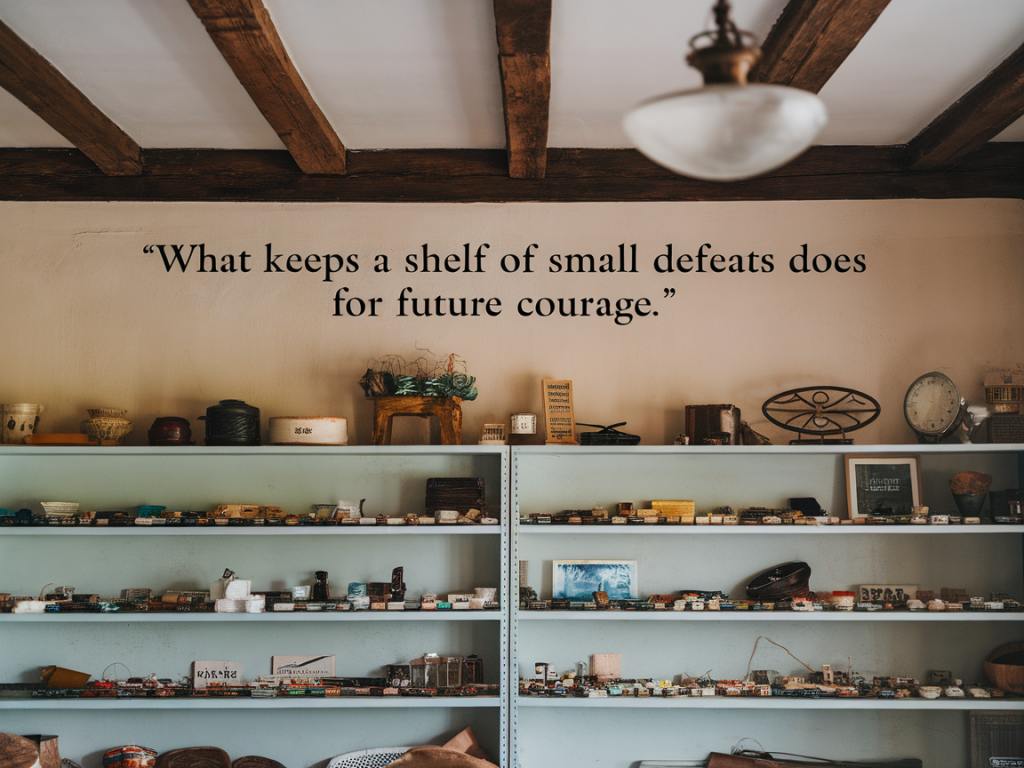
There’s a corner of my study where I keep a small, deliberate mess. It isn’t cluttered with old bills or socks; it’s a quiet shelf of objects that mark small failures, aborted attempts and the odd embarrassing experiment. A coffee-stained postcard from a failed writing residency application. A dried-up fountain pen I thought I could fix. A poorly framed photograph I insisted on printing. Each item is modest and ordinary, and together they form something like a reliquary of things that didn’t go to plan.
I started keeping that shelf almost as a joke: a physical catalog of mishaps to remind myself that perfection was not the baseline of living. Over time, though, it became a kind of ritual and, more unexpectedly, a tool for future courage. The presence of those small defeats changed the way I approached risk, not by making me reckless, but by giving me a quieter, more generous relationship with failure.
Why display your failures at all?
There’s a cultural pressure, especially in online life, to curate the narrative of continual success. Instagram is full of finished rooms, book covers, and perfectly steamed lattes. Failures are hidden, edited out, or presented only as polished anecdotes. A deliberate “shelf of small defeats” is an antidote to that: it externalizes the private, awkward parts of practice and shows them a bit of daylight.
Having a visible record of modest losses does a few things for me:
Small defeats, big effects
One of the surprises was how quickly the shelf affected my writing life. After losing a spot in a local festival because I sent a query that read like a list of achievements rather than a conversation, I kept the rejection note (a polite email) on the shelf in a little brass clip. It stared at me during late-night revisions and, somewhat absurdly, comforted me. It’s easy to forget that the people you admire have also been declined in polite, bureaucratic ways. That email reminded me not to let a single “no” become a definition.
There’s also an accrual effect. Individually, these failures were small. Collectively, they formed a catalog of experimentation. I noticed patterns: a type of pitch that repeatedly flopped, a format that repeatedly felt false in my voice. Recognizing patterns is one of the clearest ways the shelf fuels courage—it clarifies what’s worth repeating and what to retire.
How the shelf reframes shame
Shame demands secrecy. Failure, by contrast, can be spoken of, rearranged, and stored. By relocating shame from an internal, burning sensation to an external, manageable object, the shelf performs a kind of emotional translation. The sting softens when you can point to a thing and say, “This—is how I learned X.”
I remember a manuscript that felt like a creative sinkhole. I had to abandon it and the embarrassment was intense because I’d told too many people it was nearly finished. Instead of pretending it never happened, I printed the first page, folded it, and placed it on the shelf. That small act—no social media confessions, just a quiet, visible acknowledgment—untied some knots. I could see the page without having to defend or disguise it. The shame diluted into fuel.
Practical ways to build your own shelf
If the idea appeals, you don’t need an elaborate display. The point isn’t theater; it’s a practical habit that reorients your relationship with risk.
Not all defeats belong on display
There’s an ethical line to consider. Personal failures that implicate others or involve matters of privacy shouldn’t become public artifacts—on the shelf or online. The shelf is for the kinds of losses that are instructive, not for the ones that would cause harm if aired. A good rule of thumb is to ask whether this object helps you be braver or merely entertains a mean-spirited self-critique. If it’s the latter, keep it private and process it elsewhere.
How it changes decision-making
Keeping that shelf nudged my decisions toward experimentation. I found myself saying yes to smaller, stranger projects because the cost of failing was already pictured on that wood. The psychological barrier to initiating a risky idea lowered—because failing no longer felt like falling off a cliff, but like adding another small object to a collection I was building on purpose.
There’s a practical ripple as well: when I do fail, I’m less likely to catastrophize and more likely to ask useful questions. What exactly went wrong? What do I try differently next time? The shelf encourages curiosity instead of blame.
Outside the home: communal shelves
The idea scales. In a classroom, in an office, or among friends, a shared “shelf” can foster collective risk-taking. I’ve watched small community projects where people pinned failed event flyers on a wall—then, a year later, pointed to them as signposts of learning. Organizations that display project post-mortems—honest, messy summaries of what didn’t go well—tend to iterate faster and with less drama.
That doesn’t mean every workplace should become a museum of missteps, but where psychological safety exists, an institutional shelf can normalize the iterative nature of creation and reduce the stigma of early failure.
The aesthetic of encouragement
Finally, the shelf changes the aesthetics of courage. Instead of a sudden heroic leap, bravery becomes a collected practice: a steady accumulation of attempts, refusals, revisions and small restitutions. The shelf visually declares that courage is not always about triumph but about persistence. It celebrates the continuation of effort rather than the polished outcome.
Walking past my shelf now, I feel less like I’m cataloguing wounds and more like I’m observing a history of trying. The objects don’t shame me; they remind me that risk is how I learn to care about interesting things. They whisper, in their silent way, that future courage is less about exceptional boldness and more about the simple permission to fail and try again.