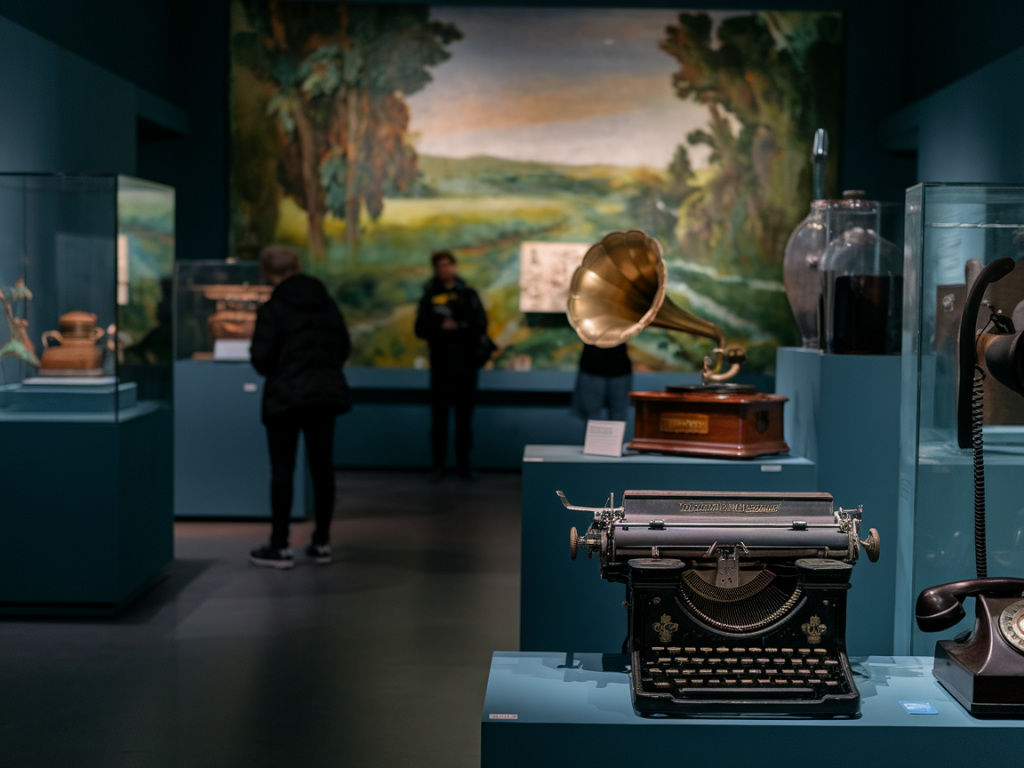
I recently spent an afternoon in a small, quiet museum that had no blockbuster exhibition, no flashy installations, and only a handful of visitors. I went intending to pass the time, to be polite to a friend who had persuaded me to join them, and to enjoy the soft light that always seems to fall differently in galleries. Instead, I found my relationship to everyday objects gently—almost imperceptibly—shifted. By the time I left, a chipped teacup and a shopping trolley felt like things I could look at afresh.
On entering and lowering my speed
There is an atmosphere that precedes any museum visit—an intake of breath, a subtle promise of containment. In that hush I felt something loosen: the urgency of the to-do list, the tiny panic that loves to narrate my day. Walking among cases and pedestals required a different tempo. The building’s quiet compelled the kind of attention we rarely grant the ordinary: slow, sustained, curious. I realized fairly quickly that this slowdown is itself a kind of practice, one worth cultivating outside museum walls.
When we move slowly we notice surfaces: the way light pools on worn wood, the faint sheen of a brass handle buffed by years of hands, the small repairs someone has made to preserve a utilitarian object. These are not decorative choices but traces of use and care. The museum seemed to say, without words, Look closely. The everyday is worthy of attention.
Objects as stories, not only function
One of the displays was unapologetically domestic: a row of kitchen implements, from a cast-iron skillet with a well-seasoned patina to a wooden spoon long smoothed by stirring. Each had a label that offered a scrap of context—who used it, when, in what household rituals. I found myself inventing the rest. I imagined breakfasts, quarrels, recipes passed down like talismans. Suddenly these utensils were not anonymous tools but actors carrying memory.
This is where the museum does something subtle and powerful: it turns objects into narratives. A shopping trolley becomes a map of a city’s rhythms; a found photograph becomes an archive of gestures. We tend to think of everyday items as disposable—the grocery bag, the cheap mug—but when you learn to read them as accumulations of human time, they become repositories of small, ordinary histories.
The strange intimacy of preserved ordinariness
There was a display of shoes—muddy boots beside a pair of ballet flats, a child’s scuffed sneakers with a missing lace. I stood there, slightly embarrassed at how moved I felt. Shoes are intimate objects. They bear the contour of a foot, the imprint of a walk, a commute, a dance. Seeing them in a case made me aware of how much of life is worn into things we seldom think about. The intimacy was not voyeuristic; it was reflective.
It reminded me how objects accumulate the traces of life in ways our memory does not. Our memories blur; objects retain an index. A lipstick stain on a coffee cup, a dent in a metal tea tin—these are small, stubborn facts. In a museum context they become accessible to wonder rather than mere evidence of imperfection.
Practical aftermath: how museum habits translate to daily life
I left with a handful of modest habits that altered how I approached my apartment the next week. They felt simple enough to test immediately.
None of these are grand gestures. Yet they changed my daily experience: the shelf became a small museum, and a moment of attention transformed the objects into companions rather than clutter.
When brand and banality meet
Brands inhabit our everyday with persuasive banality: the sleek, familiar rectangle of an iPhone, the measured simplicity of an IKEA bowl. In the museum, I found myself reconsidering how branding flattens the story of an object. A ceramic mug stamped with a corporate logo is still a mug; it is also a marker of taste, distribution, and economic systems. Observing older, unbranded objects encouraged me to notice the particularities modern design often smooths over.
That said, design can also deepen appreciation. A well-made chair—whether a mid-century piece or a HAY staple from IKEA—teaches about proportion, weight, and the thoughtfulness of an object's ergonomics. The museum’s careful curation taught me to balance critique with curiosity: question what mass-produced items erase, while also noticing what design choices enable in everyday life.
What museums train in the quietest way
One form of training a museum offers is the discipline of attention. Without shouting or spectacle, it cultivates the ability to hold something in view long enough to notice a detail that changes perception. Another training is ethical: museums preserve, and in preserving they ask whether loss and care are decisions we ought to make more consciously in our own lives.
Finally, museums encourage a conversational stance toward objects. Rather than using things solely, we might ask them questions: Where have you been? Whose hands have you known? What repair have you required? This posture turns possession into inquiry. It doesn’t make the object speak, but it opens a space where the ordinary can quietly insist on its own interest.
Small rituals to take from a museum visit
| Ritual | Why it matters |
| Slow looking for five minutes | Re-centers attention; reveals unnoticed details |
| Rotate three items into view | Reclaims value from objects in storage; creates conversation |
| Label an object with a story | Transforms ownership into narration |
None of this is prescriptive. Museums don't provide a manual for living. But they do offer a quiet technique: attention as an act of generosity toward the world. The next time you catch yourself scrolling while a cup sits cooling on the table, consider taking it to the light. You may find that, without any ceremony, the ordinary has more to tell than you first assumed.