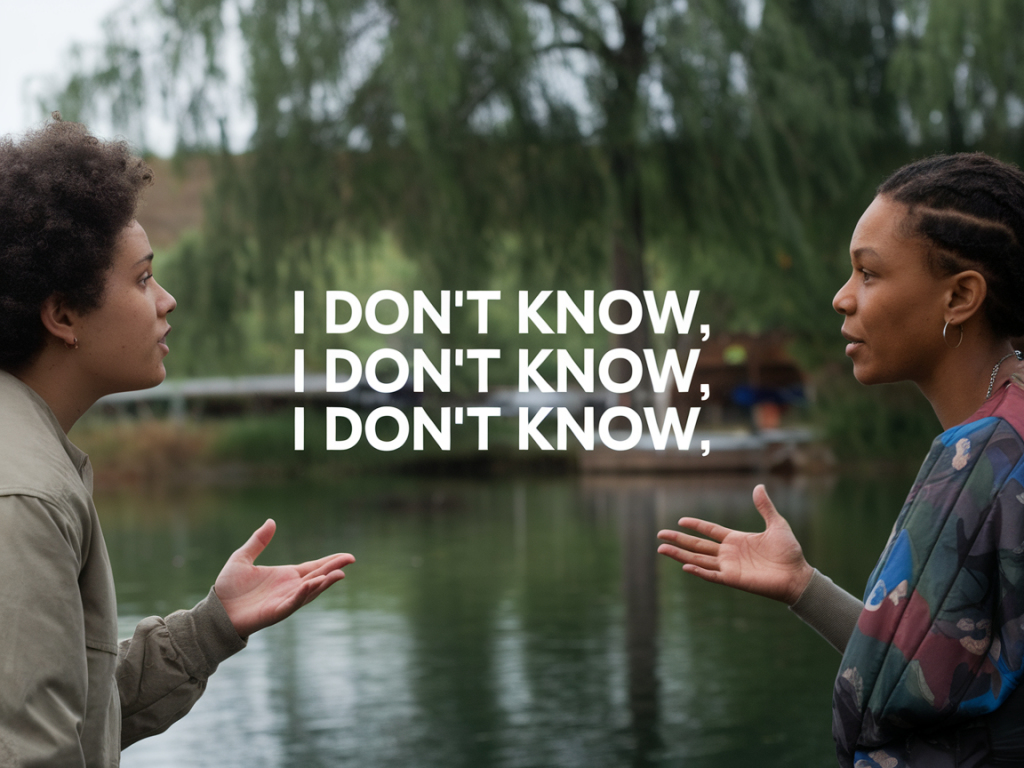
I learned a little conversational trick years ago — not from a book but from a series of awkward dinner parties and stubborn interviews where everyone seemed to be playing verbal tennis. When a question landed on me that I didn't have a neat answer for, I began to say, deliberately and aloud, "I don't know". Not once, but three times, with a brief pause between each. It felt oddly humble, almost silly at first. But over time I noticed something subtle and useful: those three repetitions were a kind of clearing of conversational undergrowth. They made room for better questions.
The gesture of not-knowing
Saying "I don't know" is usually framed as failure or admission of ignorance. We're taught to hide it, to hedge or to fake competence. I remember a moment at a publishing meeting when I fumbled for an answer about marketing metrics and instantly felt embarrassed. Later that week, a friend suggested a thought experiment: next time, try saying "I don't know" three times slowly, then pause and watch what happens. It sounded theatrical, but I gave it a go.
The first "I don't know" is a release. It stops the reflexive scramble to supply an answer that might be thin, self-protective or irrelevant. The second is a clarification: it signals that I'm not merely avoiding the question but acknowledging genuine uncertainty. By the third, something changes — the cadence becomes a little like a bell that says, "Let's recalibrate." People around me leaned in. The pressure to perform dissolved. The conversation shifted from assertion to curiosity.
Why repeating it helps
There are a few interacting reasons this works.
- It creates a pause that isn't empty. We often mistake silence for awkwardness. By placing those three words, separated by small pauses, I'm offering a defined silence that invites reflection rather than panic.
- It signals honesty rather than helplessness. A single "I don't know" can sound like shrugging. Three says: I'm engaged enough to acknowledge gaps, and I'm willing to stay with the question.
- It invites collaboration. When I declare uncertainty confidently, people often respond by offering context, stories or alternative angles. The question becomes co-owned.
- It resists the urge to answer too quickly. Many conversations are derivative of the first answer given. By withholding one, we often get richer, less reactive discussion.
Examples from real moments
I used this in a workshop on creativity where participants felt stuck. A question came up: "What's the best way to find original ideas?" I'd initially panic and throw out platitudes about reading widely. Instead, I tried the threefold "I don't know." The room relaxed. Someone said, "Maybe it depends on what you mean by 'original'." Another person described a ritual of walking local streets at dusk. We ended up talking about constraints, boredom, and borrowing — much more practical and surprising than my canned answer would have been.
In a different setting, during a conference Q&A about climate communication, an audience member asked, "How do we motivate people to act?" I could have pointed to social campaigns or policy levers, but I said "I don't know." twice more, then added, "Tell me what you think is working." The person shared a local initiative that was succeeding quietly. Others chimed in with stories that wouldn't have surfaced if I'd blurted an expert opinion. The conversation turned toward storytelling, networks, and small wins rather than doom-laden pronouncements.
How to use it without sounding evasive
There is a performative risk: repeated "I don't know" can seem like stalling or pompous if done with a smug grin. Here are some small practices that make it feel authentic and generative.
- Keep your tone curious, not defensive. Say the words gently, with attention, not as an attack on the questioner.
- Couple it with an invitation. After the third "I don't know," try: "What do you think?" or "What would you try?" or "Let's think through what matters here."
- Follow up with options, not answers. Offer hypotheses, anecdotes or constraints: "One possibility is..., another might be..." It turns the admission into a brainstorming tool.
- Use it selectively. Don't weaponize uncertainty to avoid accountability. It's best in exploratory or collaborative contexts, or when you'd otherwise give a shallow answer.
When it's especially useful
I've found this approach rich in three kinds of situations:
- Creative dead-ends. When a group is hunting for an original idea, it can help unstick the default thinking.
- Hierarchical settings. When a leader admits not knowing, it flattens the power dynamic and encourages contributions from quieter people.
- Complex questions. Climate, culture, relationships — when simple answers would be misleading, the threefold admission allows for nuance.
What it teaches us about questions
Repetition of "I don't know" reframes the question itself. It nudges us from "What is the right answer?" toward "What are the right questions?" Good questions are often messy, specific and unexpected. They force us to refine assumptions, define terms and consider trade-offs. For instance, instead of asking "How do we be happier?" the follow-up questions might become: "What kind of happiness are we after? For whom? In what time frame? What constraints exist?" Those are the conversations that reveal possibilities.
Small experiments to try
If you'd like to test this in your own conversations, here are gentle prompts:
- Next meeting, when asked for an instant opinion, say "I don't know." twice more, then ask the group: "What's at stake here for you?"
- In a disagreement with a friend, begin with three "I don't knows" and watch if their tone shifts toward explanation instead of defense.
- Use it in interviews: after an opaque question, repeat "I don't know" three times, then say, "Could you tell me what you mean by that?" You may get the precise frame you need to answer well.
There is a small humility in admitting ignorance, but it's an active humility — not surrender, not performance. It says: I'm interested enough to stay with the puzzle, to listen for the nuances, and to invite your thinking into the space. The triple "I don't know" becomes less about lack and more about method: a way to clear assumptions, broaden curiosity and, very often, arrive at questions that matter more than the quick answers we were ready to hand out.