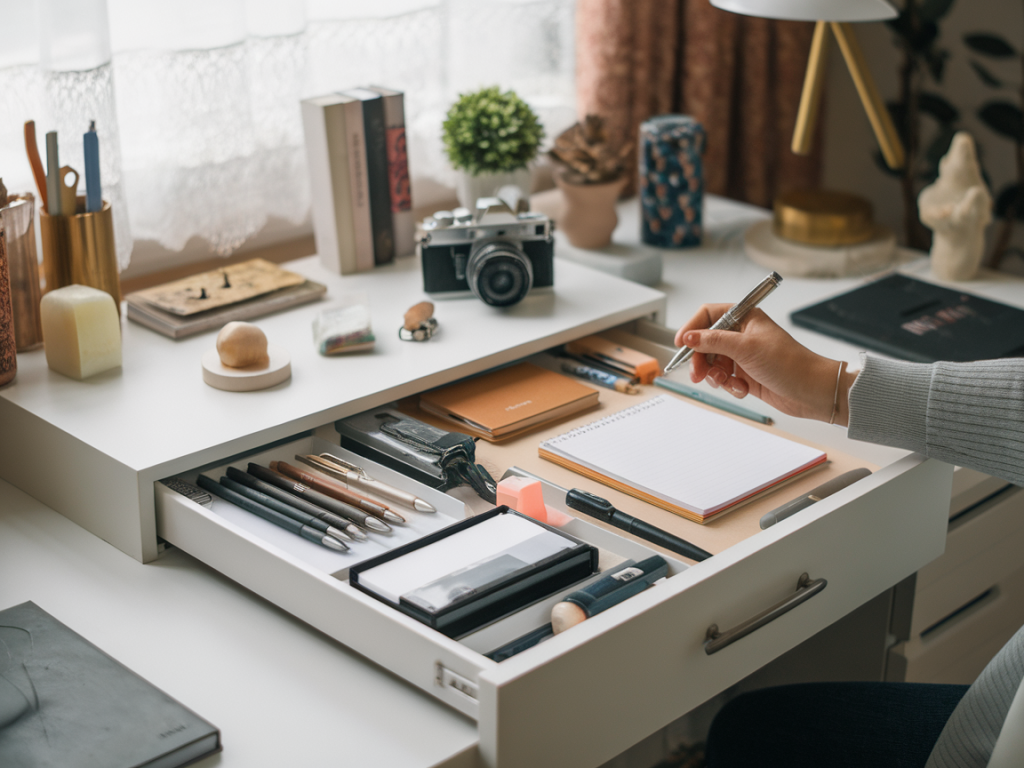
There is a single drawer in my flat that I have kept untouched in a way that feels almost intentional. It is not the bedside drawer of lip balms and medication, nor the kitchen drawer with spatulas and stray takeaway chopsticks. This is a slim, wooden drawer in the hallway console: a curated jumble of small objects — a ticket stub from a late-night cinema, a Polaroid of a rainy morning, a brass key that opened a studio door for six months, a child-sized fountain pen I found in a flea market and refused to leave behind. I call it my drawer of small witnesses. Keeping it changed the way I tell stories about myself.
Objects as modest companions
For years I told stories about myself the way many of us do: as a sequence of roles and accomplishments. I was the editor at a small press for a while, then the itinerant researcher, then the person who moved into a flat with too many books. My narratives were tidy, sometimes admirable, often shaped by what I thought others wanted to hear. But the drawer played a subtle trick on me. It invited a different vocabulary — not just the big events, but the small, tactile scenes that felt like interior stage directions.
When I open the drawer I don’t find proof of success. I find traces of attention. The Polaroid is not an award but a mood: the sharp wet edge of a jacket, a coffee cup rim, a dog passing like a punctuation mark. The brass key is not a symbol of property but of a time I made a studio my laboratory, arriving at dawn to test a new idea. Each object is a compact story that resists summary and refuses the tidy headline.
How the drawer altered my language
Stories built around objects become more specific, slower, and oddly more generous. Instead of saying, "I spent two years working on a magazine," I might describe the ritual of creaking down the spiral staircase at eight in winter, carrying a thermos of tea that never stayed hot. Instead of "I read widely," I remember the smudged dog-eared copy of a book I re-read on a train, the marginalia like a secret handshake with an unknown past self.
This shift matters because details do more than decorate a story; they coax the listener into the scene. A stranger hearing about the brass key can imagine the rust on its teeth; they can feel what it’s like to turn a lock for the first time and notice the tiny victory. A drawer pushes me to stop describing my life as a list of positions and instead to give people access to the small rooms inside those positions. It’s less about impressing and more about inviting someone to stand beside me for a moment.
Memory becomes less monolithic
Objects interrupt linear memory. I used to tell myself that I changed gradually, that chapters followed cleanly. But the drawer taught me that memory is patchwork. Pulling out a train ticket can instantly unspool a whole afternoon of strangers' conversations and the smell of wet coats; the fountain pen can lead to a week when I wrote notes in a steady, slanted hand and felt surprisingly brave. These fragments knot together in ways a CV never captures.
Inventories also reveal what we prefer to leave invisible. The items I keep are not necessarily valuable in any market sense; they are valuable because they resisted being forgotten. They act like bookmarks for moments I want to return to. In telling a story now, I sometimes reach for an object before I reach for a sentence. That tactile cue helps me avoid clichés and gives my memory permission to wander into the small, decisive gestures that actually feel like me.
Objects complicate identity
Keeping a drawer is not a sentimental indulgence; it’s a deliberate way of admitting multiplicity. Identities are often presented as consistent patches — the mother, the artist, the professional. But when I assemble my drawer, I am forced to acknowledge the cross-currents. There’s a chipped mug from a ceramics workshop I took to learn how to stop being impatient. There’s a cheap plastic badge from a music festival I went to when twenty-one and inconvenienced but happy. These items suggest that one person can contain many contradictory impulses simultaneously.
When I tell stories now, I lean into that complication. I’ll tell a room about how I love the quiet of book fairs and also confess the small, almost illicit pleasure I take in browsing airport shops. The drawer helps me resist the tidy identities we hand to one another at parties. It invites nuance rather than proof.
Conversation becomes collaborative
Objects are great conversation starters because they demand explanation. If I mention the brass key, someone inevitably asks, "What did it open?" The question encourages curiosity and often draws out other people's stories. The gesture is generous; it flips the dynamic from monologue to exchange.
At gatherings I’ve experimented with a portable version of the drawer — an old hatbox with five or six objects. People are immediately curious. We pass the items and tell little tales; memories ricochet between us. A stranger’s story about a similar key opens a door in my memory I hadn’t expected. In that way, the drawer isn’t just a sculptor of my narrative voice, it’s a communal tool for building empathy across small things.
Writing with objects as evidence
As a writer, I’ve learned to treat objects as a form of evidence that isn’t rhetorical. When I’m composing an essay, I can either assert an emotional state — "I was lonely" — or I can cite an object that proves it without grandstanding: a half-read novel left in the sink, a pair of train timetables pinned to a corkboard with no plans attached. The objects ground the narrative in the physical world so the reader can feel rather than be told.
This approach has practical benefits too. Editors and readers often complain about abstraction. Bringing an object into a paragraph gives the piece something to hold onto. It can also be a saving grace for honesty; admitting to the battered loyalty card in my wallet is often more revealing than professing big ideals.
Keeping one drawer as a practice
There’s a disciplined simplicity to the practice. I decided long ago not to let the drawer turn into a shrine or a catch-all. It’s deliberately limited — one drawer — a tiny ecosystem that resists expansion. The limit forces selection and, with it, attention. To choose an object is to ask: will I want to remember this particular evening, this particular gesture? The act of choosing is itself a form of storytelling. It’s the moment I decide what kind of narrative my life will bear, at least for now.
Sometimes I rotate objects. Sometimes I keep them for years. Recently I added a small folded map of a city I barely explored. It felt like adding a proposition to my own history: here is a place I almost lived, here is the ache of possibility. The drawer is not static; it’s an ongoing conversation with myself about what to keep and why.
It turns out that keeping one drawer changed how I tell stories because it taught me to trust the small things. Those things make narrative eccentric and generous; they complicate the tidy plots I used to offer. They invite others into the rooms where I quietly live, where the everyday and the odd rub shoulders and sometimes, if you listen closely, start to make sense.