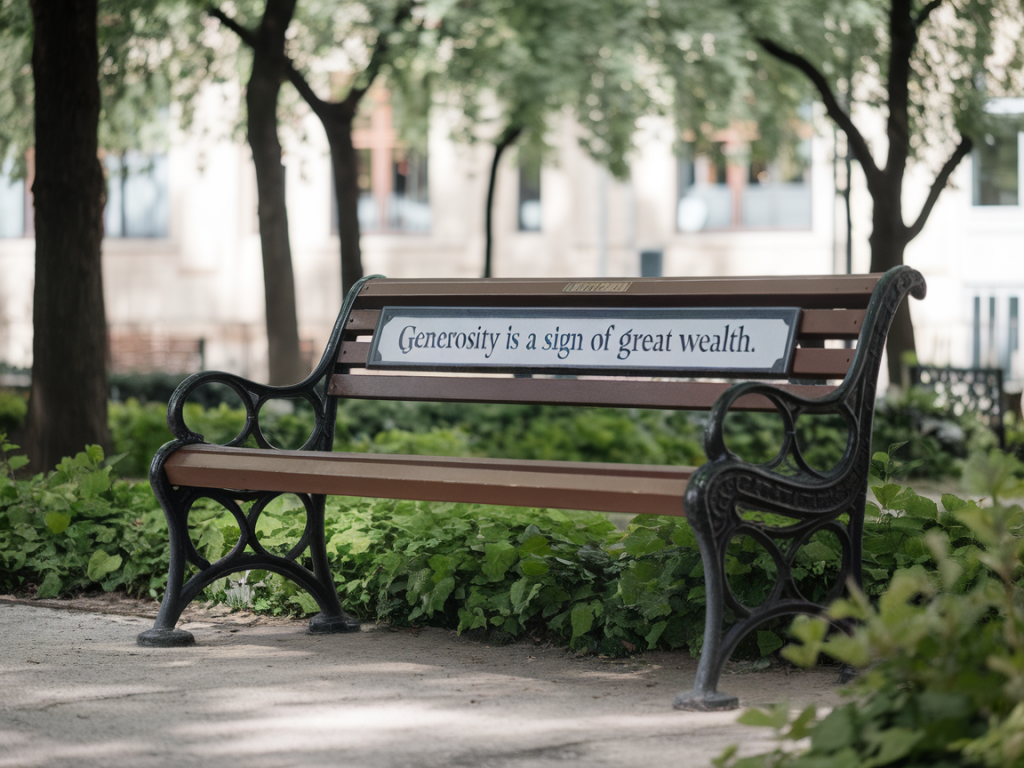
I have a habit of lingering on benches. Not in the rom-com, contemplative way that signals a life-changing montage, but in the quiet, unpaid apprenticeship of watching and being watched. One rainy Tuesday I sat on a bench beneath an overgrown plane tree outside a small train station and realised how much of what I understand about generosity comes from the small choreography that unfolds there—how people leave, take, share and repair without fanfare. It struck me that a single public bench can teach you more about generosity than a thousand advice columns.
Generosity as lived practice
Advice columns love principles: “Give without expecting,” “Set boundaries,” “Volunteer regularly.” They are helpful signposts, and I keep a well-thumbed stack of them like talismans. But a bench shows generosity in motion—the awkward, imperfect, often nonverbal ways it actually behaves. On that bench I watched three practices repeatedly:
Those acts are not performed for admiration. They are often anonymous, unnoticed by the wider world. Advice columns can teach you the right words to say and scenarios to avoid, but they rarely make space for these small, ambiguous forms of giving—giving that is muddied by inconvenience, by social awkwardness, by the real needs entwined with the daily rhythms of life.
How constraints shape generosity
A bench is defined by its limits: length, seat width, the sheltering curve of a backrest. Those physical constraints shape behaviour. I noticed that when there is room for exactly three people, negotiations happen. The fourth person approaches and we watch a micro-morality play: does someone rise? Do legs cross? Do bags get rearranged? These small decisions expose a lot about how people judge one another, and how generosity only makes sense against the backdrop of scarcity.
Advice columns often speak in absolutes: be generous. But generosity in the world of the bench becomes conditional. It is generosity as compromise. That is a valuable lesson: generosity is not always abundance; often it is the willingness to rearrange your scarce resources—time, space, patience—for someone else.
What the bench teaches about reciprocity
There is a fallacy I often see in written advice: reciprocity is a neat ledger. You give this, someone owes you that. The bench undermines that tidy bookkeeping. A woman once sat beside a teenage boy who smelled faintly of damp coats. She offered him the newspaper she’d been reading. He smiled, nodded, and later, when she stepped away to make a phone call, he took off his beanie and handed it back. We might call that repayment, but the moment felt less like a debt settled than a shared understanding—a passing-on.
On the bench, reciprocity is both immediate and deferred. Sometimes the person who receives does not return the favour at all. Sometimes they do, but in a different currency—word-of-mouth about a small favour, a recommendation for a good barber, a bottle of water pulled from a backpack on a hot day. The transactions are kaleidoscopic. Advice columns that insist on equal exchange miss how generosity functions as a social glue: it creates expectations, networks and obligations that are elastic rather than exact.
The moral education of strangers
One of the more surprising lessons is how generosity is taught by bystanders. I watched a toddler prod a pigeon and an older woman scold her gently—“Don’t be unkind.” That scolding was not just to the child; it was a social reminder to everyone within earshot. A man helped a woman with a pram up the curb, and two teenagers applauded quietly, the way you might clap after good theatre. These moments teach civility by example.
Advice columns often frame generosity as a private virtue. The bench shows generosity is communal pedagogy: we learn how to act by watching others do it badly, clumsily, well. Observing the practice makes you more likely to practice it yourself.
A small table of comparisons
| Advice columns | The bench |
|---|---|
| Principle-driven | Situation-driven |
| Clear moral instructions | Ambiguous, context-specific actions |
| Often individualistic | Collective and observational learning |
| Language-focused | Gesture, space and small acts |
Why the bench humbles advice
Advice columns presume a reader who can act on the advice in predictable ways. They assume access—to time, money, safety—that many people do not have. The bench, by contrast, is a kind of egalitarian laboratory. It throws together commuters, students, parents, the homeless, tourists; everyone is momentarily equal in the face of the bench’s finite seats. Generosity here isn’t heroic; it’s ordinary survival mixed with moral imagination.
There was a man who slept on that station bench over several nights. He kept his shoes neatly beside him. People left coins, a thermos, once a hand-knitted scarf draped across the backrest. Sometimes a passerby muttered; sometimes someone stopped to talk and left with a lighter step. The bench turned anonymous compassion into an ecosystem of responses—no advice column could replicate that nuanced, situational ethic.
Practices worth borrowing from the bench
If you wanted to translate what the bench teaches into everyday life, here are a few tiny practices worth trying. They are not maxims; they are habits that helped me be more generous in practical ways.
These are not bulletproof rules. They are experiments you can run in your neighbourhood, office, or travel. The bench teaches that generosity is a series of micro-adjustments, not a one-off grand gesture.
I still read advice columns. I find comfort in clear language and sensible frameworks. But when I want to remember what generosity feels like in practice, I head to the nearest bench—sometimes with a book, often with nothing at all—and let the small civic theatre of pedestrians, packages and umbrellas remind me what it means to hold space for another person. W Oswald Co explores ideas in patches like that: things felt and observed rather than prescribed. The bench is a generous teacher—quiet, imperfect and undeniably human.