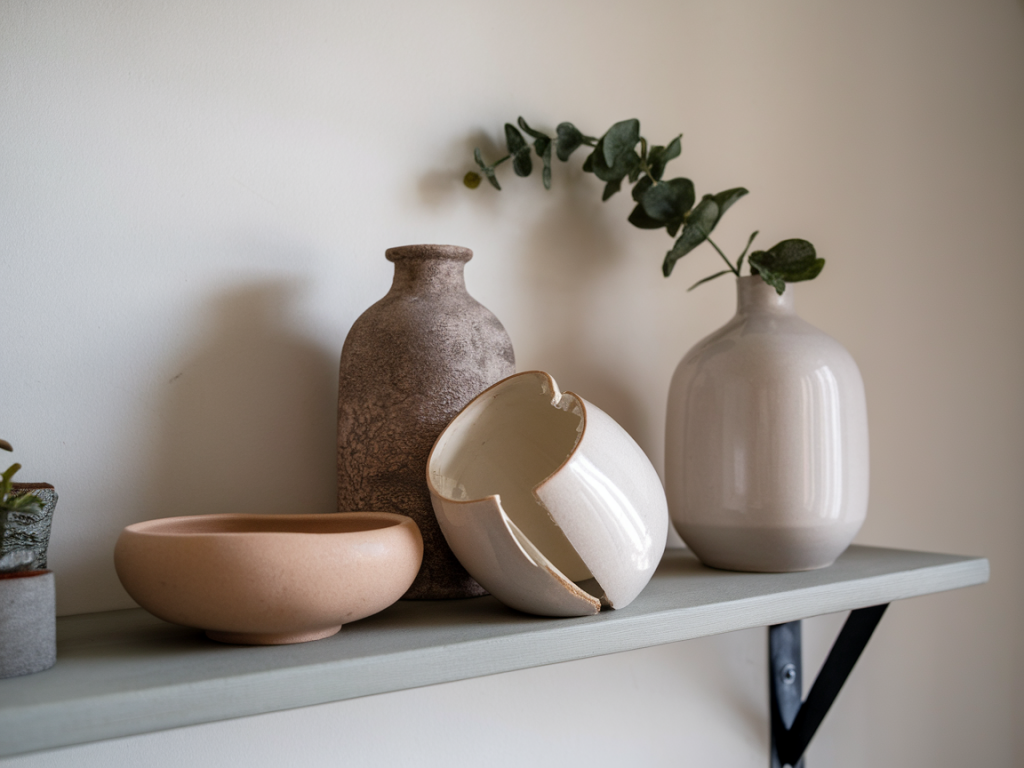
There is a single broken thing in my flat that everyone notices. It’s not the kind of break that needs repair to function — a crack running like a river through the rim of a ceramic bowl I bought at a flea market years ago. I use it sometimes for fruit, sometimes to hold keys, and sometimes merely as an object to catch my eye when I’m making tea. I have never glued it back together. Instead, I left it where it can be seen. People ask why. I answer, usually: because the crack makes it more honest.
Why keep a broken object on display?
Keeping a single broken object visible is a small, deliberate act. It asks a quiet question about what we value: do we prize perfection, or do we prize memory, use, and the texture of a life? For me, the cracked bowl is a locus of stories — a rainy Saturday in Antwerp, an awkward conversation with a seller at the market, the first apartment I had after I left a steady job. It carries a density that a pristine, anonymous bowl could never hold.
People often wonder whether displaying a damaged item is an admission of neglect. I don’t think so. Choosing to keep and showcase an imperfect object can be one of the clearest ways to show intentionality. It says: I know what this is and what it has been through, and I’ve decided it’s worth attention. It also shifts our relationship with objects from transactional to relational. When you honour a stain, a chip, or a missing button, you’re honouring continuity: the idea that things live with us and change with us.
What does a broken object reveal about you?
When someone keeps a single broken item on display, it signals several possible values, sometimes at once.
- Attachment to memory: The object is a physical bookmark to a moment or person. I can reach for my bowl and, for a second, feel that Saturday again.
- Resistance to disposability: In an age of constant replacement, keeping a broken object is a small refusal to throw away what still has use or meaning.
- Acceptance of imperfection: It signals comfort with complexity — that life is patched-together and still beautiful.
- A sense of aesthetics: Sometimes a crack is simply visually interesting. Kintsugi taught many of us to see gold in the fracture.
- Carefulness: Ironically, displaying a broken thing can show care: you decide not to hide it or discard it; you integrate it into your living space thoughtfully.
These signals aren’t mutually exclusive. My bowl is practical, sentimental, and aesthetic. The people who live with you will infer different things based on their own values — a friend who prizes minimalism may read your bowl as clutter; another who loves stories will see a little shrine.
How do you choose which broken thing to display?
There’s a difference between a discarded pile of cracked cups and a single, carefully chosen object. If you’re thinking of leaving something on view, ask yourself a few questions.
- Does it bring back a memory you want to revisit?
- Is it safe and stable to keep on display?
- Does it have visual interest — a texture, a pattern, a line — that complements your space?
- Can it be framed, intentionally placed, or lit in a way that doesn’t make it feel like an accident?
- Is it serving a function, symbolic or practical?
One person’s heirloom teacup might be another’s chipped trash. I recommend starting small: choose one object that feels rich in story or form, and see how it changes the room’s tone. For me the bowl’s crack is a line that draws the eye; for someone else it might be a dented watch, a torn denim jacket folded over a chair, or a Polaroid with a corner missing.
Display ideas that honour the fracture
How you display a damaged object matters. The goal is to make the break intentional rather than accidental. Here are approaches I’ve tried or admired:
- Elevate the object: put it on a plinth, a wooden tray, or a small shelf so it reads as deliberate. That way the damage becomes part of the composition.
- Frame it: for paper objects or textiles, a glass frame (with spacers so it doesn’t press flat) turns vulnerability into exhibition.
- Pair it with the right light: a lamp angled to highlight texture can make a crack look like a mark of living rather than neglect.
- Contrast with the new: place the broken thing next to something immaculate — a new hardcover book, a modern vase — to create a dialogue.
- Label it, quietly: a handwritten note or small tag explaining why it matters can transform curiosity into connection.
Common questions people ask — answered
Isn’t it a bit sad to keep something broken? Sometimes. But sadness isn’t the same as shame. A broken object can be tender, poignant, and alive with memory. Keeping it can be a gentle way to practice presence with loss or change.
Do people think you’re trying to make a statement? They might. That’s okay. We make statements through things we hold onto. Often the statement is quieter than people expect: not a manifesto, but a small insistence that some parts of a life be kept visible.
What if the object could be repaired? Repair is a meaningful choice too. Kintsugi, for instance, celebrates mending with gold. But choosing not to repair is itself a choice. I sometimes repair things and sometimes don’t; both are honest responses depending on the object’s function and story.
Is this a sustainable practice? In a world of fast consumption, intentionally retaining and displaying a broken item is a tiny sustainable gesture. It’s a reminder that objects don’t lose their worth when they lose their sheen. And sometimes keeping one treasured imperfect thing prevents the buying of lots of new, forgettable things.
A small table of meanings
| Object | Possible meaning |
|---|---|
| Cracked bowl | Memory, domesticity, understated beauty |
| Dented watch (e.g., old Rolex handed down) | Continuity, lineage, the passage of time |
| Torn denim jacket | Personal history, lived-in comfort, style as narrative |
| Scratched Leica camera | Workmanship, the life of an object in action, creative investment |
There’s a pleasure in choosing one broken piece to live with you rather than burying all evidence of damage. It keeps your space honest. It keeps your stories close. And it reminds you — softly, in a language of lines and glints — that value is not the same thing as flawlessness.